Forging the economic engine
By Muhammad Azfar Ahsan
Pakistan's core problem isn't a lack of potential, but the absence of an economic architecture that can convert capital into productive investment, investment into productivity, and productivity into exports and national strength. Stabilization alone is not development what's needed is a "development state" that sets predictable rules, enforces contracts, protects competition, and builds the confidence for private capital to take productive risk, rather than a state that tries to control every outcome.
Building this engine requires action across many fronts at once: mobilizing domestic investment before foreign capital, reforming taxation and regulation, investing in human capital and infrastructure, strengthening exports and competitiveness, and ensuring policy continuity across political transitions. The author argues these pieces are interconnected reform must be treated as a system, not isolated announcements and that Pakistan's real challenge is institutional discipline: the ability to execute consistently and turn potential into sustained, compounding national performance.
August 17, 2026
Published in Pakistan Today on August 17, 2026
Pakistan does not lack potential. It lacks an economic engine capable of converting that potential into sustained national strength.
We have the raw material: a large domestic market, a young population, entrepreneurial energy, strategic geography, natural resources, and a private sector that has repeatedly created value despite difficult circumstances. What we have not built is the institutional architecture capable of converting capital into productive investment, investment into productivity, productivity into exports, and exports into rising incomes, fiscal capacity and national power.
Having worked at the intersection of government, investment and business, I have learned that capital does not move simply toward opportunity. It moves toward opportunity that can be understood, risk that can be priced and rules that can be trusted. Investors can tolerate complexity and difficult operating environments. What they cannot easily price is uncertainty about taxation, regulation, approvals, contracts or whether today’s policy will survive tomorrow’s political transition.
This is why Pakistan’s economic challenge is larger than the latest fiscal deficit, balance of payments pressure, FDI figure or export target. These indicators matter, but they are symptoms of a deeper weakness: we have yet to create an economic architecture in which capital, enterprise, productivity, human capability and public policy reinforce one another.
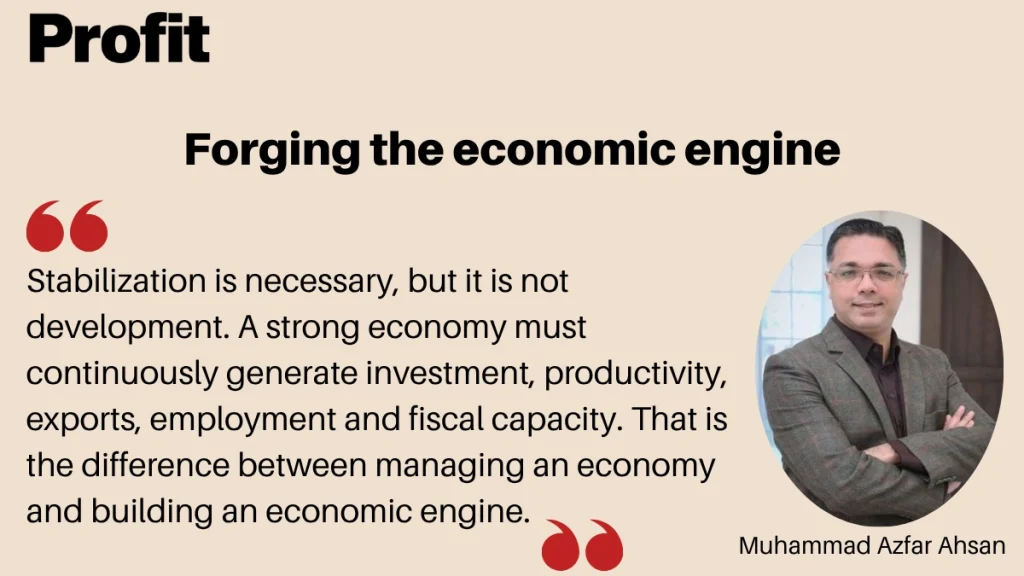
Stabilization is necessary, but it is not development. A strong economy must continuously generate investment, productivity, exports, employment and fiscal capacity. That is the difference between managing an economy and building an economic engine.
A development state is not a larger state or one that seeks to control more of the economy. It is a state that knows what it must do, what it should stop doing and where public intervention can create the greatest national value. Its responsibility is to establish predictable rules, enforce contracts, protect competition, invest in human capital and infrastructure, facilitate enterprise and create the confidence under which private capital can take productive risk. The objective is not to replace markets. It is to make markets work better.
For Pakistan, that begins with investment. FDI can bring capital, technology, management expertise, market access and connections to global value chains, but it cannot substitute for domestic capital formation. An economy of Pakistan’s scale cannot build durable prosperity by waiting for foreign capital.
The first investment signal must come from within. Are Pakistani businesses willing to expand capacity, modernize, formalize, innovate and commit capital for the long term? When domestic investors reinvest confidently, foreign investors notice. When domestic capital becomes defensive, they notice that too. Domestic and foreign investment should therefore be complementary: domestic capital provides depth and resilience, while foreign capital can accelerate technology, capability and international market access.
Investment facilitation must become a continuing economic function rather than an event. Attracting an investor is only the beginning. The real test is whether that investor can establish, obtain approvals, access infrastructure, resolve legitimate grievances, operate efficiently, reinvest and expand.
Pakistan therefore needs an investment confidence architecture, not another investment promotion campaign. Federal, provincial and local institutions must coordinate around the investor’s journey, with time bound approvals, credible grievance mechanisms and durable policy commitments. An investor should experience one coherent state, not a collection of disconnected departments. The same principle must apply to domestic entrepreneurs: domestic reinvestment is among the clearest measures of confidence in the country’s future.
But capital becomes economically meaningful only when it raises productivity. The more consequential question is whether investment expands productive capacity, introduces technology, raises efficiency, creates skilled employment, generates exports and improves competitiveness.
Productivity is the mechanism through which economic architecture creates value. Better infrastructure lowers costs; reliable energy improves industrial utilization; technology raises efficiency; competition drives innovation; human capital enables higher value production; efficient logistics connect producers to markets; modern finance allocates capital more effectively; predictable regulation reduces uncertainty. The engine works when these forces reinforce one another.
Pakistan must, therefore, judge economic progress less by the volume of activity it generates and more by the productive capacity it builds. Strength comes from the ability to produce competitively, innovate continuously, export consistently and create opportunities that survive political cycles. That requires changing how the state taxes, spends, regulates and allocates resources. Taxation cannot remain an exercise in extracting more revenue from those already visible within the formal economy. A credible tax system must broaden the base; it must make formalization simpler, compliance predictable, and enforcement intelligent; using technology and better data. The tax base should expand because the productive economy expands.
Public expenditure requires the same discipline. A development state cannot call every government outlay development. The relevant question is what productive and social capacity each rupee creates. Education, health, infrastructure, research, digital systems, and justice can generate returns for decades; expenditure that merely preserves inefficient structures or postpones structural decisions does not.
State Owned Enterprises (SOEs) require a practical rather than ideological test. The question is not whether every SOE must be privatized or retained, but whether state ownership creates greater national value than credible alternatives. Where the private sector can perform better under effective regulation and competition, the state should release capital and administrative capacity. Where public ownership remains necessary, the enterprise should have a defined purpose, professional management, measurable performance and genuine accountability.
The principle is straightforward: the state should own what it must, regulate what it should, and enable everything else to become more productive.
Regulation deserves the same rethinking. Businesses experience the state not through policy documents but through licenses, inspections, tax notices, approvals, customs, utilities and courts. Every unnecessary permission adds cost; every ambiguous rule creates uncertainty; every discretionary decision creates room for delay. Regulatory reform should, therefore, be treated as a growth strategy: fewer unnecessary permissions, clearer rules, time bound approvals, transparent digital processes, and regulators capable of protecting the public interest without suffocating legitimate enterprise.
Competition is equally important. Inefficient incumbents cannot be protected indefinitely and still be expected to become productive. Competition forces firms to reduce costs, improve quality, adopt technology, and respond to customers. Removing unnecessary barriers to entry is, therefore, not merely about fairness; it is a productivity strategy.
Technology can multiply these gains. Pakistan should no longer treat the digital economy as a narrow sector alongside the real economy. Artificial Intelligence (AI), automation, cloud infrastructure, digital payments, and data systems are becoming capabilities across the economy. They can lower transaction costs, improve tax administration, modernize logistics, expand financial inclusion, and connect Pakistani businesses to global markets. But technology cannot compensate for bad processes. A digital bureaucracy that preserves unnecessary procedures simply puts inefficient bureaucracy on a screen. Digitization must begin with process reform.
Human capital is equally central. A young population becomes a dividend only when people are educated, healthy, skilled, and connected to productive opportunity. Pakistan cannot build a high productivity economy while millions of children remain outside quality education, technical training remains disconnected from industry, and universities remain distant from the needs of a changing economy. Human capital is not a social sector afterthought; it is economic infrastructure.
Infrastructure must be judged by the same standard. Roads, ports, energy, water, telecommunications, and logistics matter because they lower the cost of producing, moving, and selling. The test should not simply be the size or visibility of a project but also the productive capacity they unlock, the markets they connect, and the efficiency they create.
Our cities deserve particular attention. Urbanization will increasingly determine national productivity. Transport, housing, utilities, municipal services, and digital connectivity affect labor mobility, investment decisions, and the cost of doing business. Stronger local governments can improve service delivery and economic planning where citizens and businesses actually experience the state. This requires better coordination among federal, provincial, and local institutions because investment, industry, agriculture, skills, infrastructure, and urban development do not respect administrative boundaries.
The same integrated thinking must shape exports. Pakistan cannot build durable prosperity through domestic consumption, borrowing, and periodic external financing. Exports bring foreign exchange, but their deeper value is that they force firms to meet international standards of cost, quality, reliability, technology, and efficiency.
The answer to weak exports is, therefore, not another package of incentives. It is a competitive production system. Exporters need reliable energy, efficient logistics, skilled workers, modern machinery, finance, technology, and predictable taxation and regulation. Export competitiveness is created long before a product reaches a port.
Pakistan must also broaden what it exports. Traditional agriculture and manufacturing remain important, but higher value manufacturing, engineering, pharmaceuticals, specialized agriculture and processing, technology enabled services, and other knowledge intensive activities offer greater room for the next phase of growth. We must move from exporting what we happen to produce toward deliberately developing the capabilities global markets demand.
That means raising productivity across sectors. Agriculture needs better irrigation, seeds, mechanization, storage, processing, and market access. Manufacturing needs technology, scale, quality, and integration into global value chains. Services need connectivity, skills, and regulatory frameworks that permit international competition. The engine cannot be built around a handful of favored sectors; it must create conditions in which productive activity can emerge, scale, and compete wherever Pakistan possesses or can develop a genuine advantage.
Capital formation is another essential component. Capital is savings converted into factories, machinery, infrastructure, technology, and businesses. When savings flow into productive investment, an economy expands its capacity. When capital remains trapped in speculative or low productivity activity, the economy may look busy without becoming stronger.
Pakistan, therefore, needs a financial system capable of mobilizing long term domestic savings into productive investment. Banks, pension funds, insurance companies, mutual funds, development finance institutions, and capital markets can play a larger role in financing infrastructure, industry, technology, and entrepreneurship. The financial architecture should reward productive risk-taking rather than disproportionately financing short-term consumption or government requirements.
But an economic engine cannot run on capital alone. It requires confidence, and confidence is ultimately institutional. A company deciding whether to build a factory, an investor considering a long-term commitment, or an entrepreneur deciding whether to expand – all represent making judgments about the future. That judgment depends on whether the state can make credible commitments.
Policy continuity is, therefore, a form of economic infrastructure. A road connects a producer to a market; predictable policy connects today’s investment to tomorrow’s expected return. Abrupt tax changes, regulatory reversals, administrative disruption, and political cycles break that connection. Businesses delay expansion, investors wait, and productive capital seeks more predictable environments.
Pakistan needs agreement on a core economic direction that survives political transitions: fiscal discipline, investment confidence, export competitiveness, human capital, energy security, productivity, digital transformation, and institutional reform.
Economic transformation takes time. Factories take time to establish, skills to develop, export markets to win, and institutions to mature. Confidence takes longer still. The cost of inconsistency is measured not only in lost investment but in opportunities that never materialize.
This makes execution as important as policy. What we have lacked is institutional discipline to carry priorities from announcement to implementation and from implementation to measurable outcomes. A ministry should know what it is expected to deliver, how success will be measured, and who is accountable.
This requires a professional civil service with stronger economic expertise, clear mandates, and continuity in key positions. Capable officials must have the authority to execute and be held accountable for results. Political leadership must provide direction without repeatedly disrupting the machinery responsible for implementation.
That culture must extend beyond government. The private sector is Pakistan’s principal engine of enterprise, investment, innovation, and employment. But a stronger state does not mean permanent protection from competition or commercial risk. Pakistani companies must invest in technology, management, skills, governance, and export capability. Protection may provide breathing space; it cannot create globally competitive industries indefinitely.
Corporate Pakistan should become an active partner in national development, contributing to skills, research, innovation, and export capability while government creates conditions in which those investments make commercial sense. Universities and research institutions must also move closer to the productive economy. Applied research, commercialization, technology transfer, and industry-linked skills should become components of national productivity. The distance between an idea and its commercial application, a university and a factory, a technical institute and an employer, and Pakistani talent and global markets must become shorter.
The same principle applies to digital transformation and investment facilitation. Pakistan does not need another layer of institutions competing to announce investors; it needs an institutional system that makes Pakistan easier to invest in. An empowered investment institution should coordinate across government, identify bottlenecks, facilitate legitimate investors, and ensure that commitments are implemented. An investor should not have to understand Pakistan’s administrative architecture to do business in Pakistan.
The most valuable investment incentive is often not another concession. It is predictability. Domestic investors deserve the same treatment, because their willingness to reinvest is itself a measure of confidence.
The government must also be selective about where it deploys public capital and institutional energy. It cannot finance every ambition; it must identify the constraints holding the economy back and concentrate scarce resources on removing them, whether through energy reform, logistics, infrastructure, commercial courts, tax reform, skills, or regulation.
Reform must, therefore, be understood as a system rather than a collection of announcements. A tax measure that raises the cost of formalization can weaken investment; an energy reform that makes industry uncompetitive can damage exports; a tariff structure that protects inefficient production can reduce innovation; and an investment incentive without market discipline can attract capital without creating competitiveness.
The parts of the engine must move together. Investment policy affects exports; energy policy affects industrial competitiveness; education affects technology; taxation affects formalization; infrastructure affects productivity; competition affects innovation. Pakistan’s deeper reform challenge is the state’s ability to see these connections and govern accordingly.
That requires a small number of national economic priorities that survive political transitions – strengthen human capital, deepen domestic investment, attract quality foreign investment, raise productivity, expand exports, modernize infrastructure, improve fiscal capacity, digitize government, strengthen competition, and build institutions capable of execution.
The state’s role within this architecture must remain clear. It should provide macroeconomic stability, enforce contracts, protect competition, invest in public goods, and remove constraints that prevent citizens and businesses from creating value. It should not attempt to determine every commercial outcome. The choice is not between government and markets, but between a capable government that enables productive markets and a weak government that leaves uncertainty, privilege, and inefficiency to shape outcomes.
There is no shortage of countries competing for capital, technology, talent, and markets. Pakistan cannot assume that its size, geography, or potential will automatically become economic advantage. Potential creates possibility; institutions convert possibility into performance.
That is the lesson I have drawn from working with investors, businesses, policymakers, and decision makers in Pakistan and across the international investment community. Serious investors rarely ask whether a country has potential. They ask whether its institutions can convert that potential into predictable opportunity. Businesses do not need another assurance that reform is necessary. They need confidence that the rules will remain credible long enough to justify investment. Young Pakistanis do not need another speech about their country’s promise; they need an economy capable of giving that promise practical meaning.
The economic engine is not another government program; it is the architecture through which a country converts capital into productive investment, investment into productivity, productivity into exports, and exports into rising incomes, resilience, and national strength.
Pakistan has the raw material. We have the entrepreneurs, the market, the talent, the geography, and the ambition. What we have lacked is the institutional discipline to connect them and allow their combined strength to compound.
For too long, we have treated every economic crisis as an event to be managed and every recovery as a reason to resume business as usual. The real task is harder: to build institutions and productive capabilities strong enough to make the next crisis less damaging and the next opportunity more valuable.
Pakistan does not need another promise of transformation; it needs the discipline to make transformation cumulative. The engine is not waiting for better circumstances; it is waiting for better choices.
And the time to build it is now!
Muhammad Azfar Ahsan is a public policy advocate, business strategist, and former Minister for Investment of Pakistan. He advises leading corporate entities on policy advocacy, strategic communications, investment strategy, and leadership positioning, and writes regularly on the economy, governance, and national development.

MUHAMMAD AZFAR SHAH
Articles


