COCKROACHES: The Invisible Majority
By Muhammad Azfar Ahsan
The essay uses the term "cockroaches" a slur recently aimed at Pakistani citizens as a metaphor for a deeper failure: millions of Pakistanis are forced to endure broken schools, healthcare, and justice systems because the state gives them no alternative. The August 26 PIMS hospital fire, which killed fourteen newborns, becomes the piece's central symbol of state failure.
The author argues Pakistan's real problem isn't too much or too little government, but weak capability a cycle of firefighting crises instead of fixing the institutions that cause them. He blames elite capture: when merit doesn't create opportunity, citizens turn to connections and patronage instead, eroding trust in the system and discouraging real investment. Political parties, he says, keep changing governments without changing how the state actually functions.
His call to action: shift Pakistan from a "state of permission" to a "state of performance" deliver core services, dismantle elite privilege, enforce accountability, empower local government, and rebuild the economy on merit, not access. He ends with a direct appeal to Army Chief Asim Munir to use this moment to strengthen institutions, not just stabilize them, arguing Pakistan has resilient citizens what it lacks is a state that matches that resilience.
August 31, 2026
Published in The Pakistan Today on August 31, 2026

There are words that describe a condition, words that provoke a reaction, and words that expose a reality we would rather not confront. “Cockroaches” may now be one of them.
I do not use the word to insult Pakistan’s young people or any Pakistani citizen. I use it deliberately because it has entered our public consciousness and, if we look beyond the controversy surrounding it, offers an unsettling metaphor for a much larger national failure.
For years, millions of Pakistanis have been expected to endure what no functioning state should ask its citizens to endure: inadequate education, unaffordable healthcare, insecure livelihoods, delayed justice, failing municipal services, arbitrary regulation, weak institutions, and diminishing economic opportunity. They have learned to adjust, improvise, and survive because the system has given them little choice.
Perhaps that is where the metaphor begins. The real “cockroaches” are not the people; they are the citizens whom the system has expected to survive whatever it throws at them.
They are not a generation, a class, or a political constituency. They are the millions whose rights exist formally but whose access to those rights remains painfully unequal: citizens who pay taxes, obey laws, educate their children, build businesses, work, produce, and send remittances, yet too often encounter a state that demands more than it delivers.
This is, therefore, not an article about a word; it is about what that word allows us to see: a state increasingly distant from the people it exists to serve; a governing system that spends too much energy managing crises and too little transforming institutions; an economy constrained by weak governance and elite capture; political parties that have repeatedly changed governments without fundamentally changing the governing model; and a citizen-state compact steadily losing its meaning.
If “cockroaches” has entered our vocabulary, let us give it a meaning worthy of the moment: a metaphor for the invisible majority and a challenge to build a state that can no longer afford not to see them.
The Invisible Majority
Pakistan’s greatest national asset is its people, yet millions experience the state not as an enabler of opportunity, security, and dignity, but as an institution that appears selectively, often when it wants something from them and too rarely when they need something from it.
The state expects citizens to follow the law, work, invest, pay taxes, vote, send remittances, and contribute to the economy. These are legitimate obligations of citizenship, but citizenship is not a one-way contract. The state has equally fundamental responsibilities: education, healthcare, security, justice, infrastructure, economic opportunity, predictable regulation, and a fair environment in which merit can translate into mobility. These are not favors bestowed by the government. They are the foundations upon which a modern state earns the confidence of its citizens.
The Pakistani citizen is not asking for charity when he demands a functioning school, a safe road, a hospital that provides care, a police force that protects, a court that delivers timely justice, or a regulatory system that allows a business to operate without arbitrary obstruction. He is asking the state to perform the responsibilities that give citizenship practical meaning.
That principle became painfully concrete on August 26, when at least fourteen newborns died in a fire in the Mother and Child Health Ward at the Pakistan Institute of Medical Sciences (PIMS) in Islamabad, a public hospital where their families had placed them in the care of the state. The government ordered an investigation, while UNICEF called for an urgent review and strengthening of fire-prevention and safety standards across health facilities.
The tragedy must first be mourned as a human loss. But it must also force a harder institutional question: what happens when a foreseeable risk encounters a system that is not sufficiently prepared to prevent it, contain it, or protect the most vulnerable when disaster strikes?
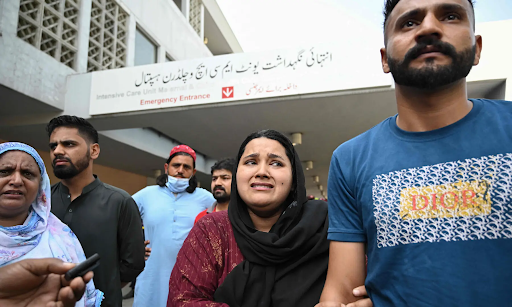
The cause of the fire and individual responsibility must be established by the investigation. The larger institutional responsibility, however, is clear: a government hospital must be safe for the people entrusted to it. Fire protection, emergency preparedness, functioning equipment, evacuation procedures, trained personnel, and effective oversight are not luxuries; they are basic expressions of state capacity.
The newborns who died at PIMS could not ask the state to protect them. Their parents had already done so by entrusting their lives to the hospital.
This tragedy cannot simply become another cycle of condolences, inquiries, recommendations, and headlines. The real test of an inquiry is not whether it identifies failure, but whether the institution is different afterward. A capable state does not merely investigate failure; it learns from it, corrects it, and prevents its recurrence.
Pakistan does not simply need more governance. It needs good governance; it needs a more capable state that knows where its presence is essential, where it should step back, and where institutional capacity can create the greatest public value. The question is not how much the state does, but how well it performs the responsibilities that only the state can discharge.
A state can be large without being strong, intrusive without being capable, and busy without being effective. State capacity is measured not by the number of ministries, regulations, offices, or programs it maintains, but by its ability to make decisions, implement them, enforce standards, coordinate institutions, measure outcomes, correct failures, and learn from experience.
The problem is, therefore, neither simply too little government nor too much government. The state can be overextended where intervention creates little public value while remaining incapable where its presence is indispensable. A state does not become capable merely by expanding its footprint; capability begins when authority is translated into outcomes.
Pakistan continues to confront this gap at an enormous scale. Millions of children remain outside school, while the economy struggles to create sufficient productive employment for a rapidly expanding working-age population. A child denied quality education represents lost human capital; a graduate denied meaningful opportunity represents lost productivity and confidence; a citizen denied justice becomes less likely to believe in institutions; and a family forced to purchase privately what the public system should provide is effectively paying twice for citizenship.
The middle class deserves particular attention. It pays taxes, utility bills, school fees, healthcare costs, transportation expenses, and often private security costs while continuing to finance a public system from which it frequently receives inadequate services. It increasingly carries the burden of a state that is expensive to sustain and insufficiently effective to trust.
A state cannot indefinitely demand the obligations of citizenship while failing to deliver the rights and services that make citizenship meaningful. That is where Pakistan’s crisis becomes deeper than an economic downturn, a fiscal imbalance, or a political disagreement. The social contract between citizen and state is steadily fraying.
A system in paralysis
For years, we have treated symptoms while leaving the structures that produce them largely intact. A fiscal crisis arrives and we fire-fight; an energy crisis emerges and we fire-fight; inflation accelerates and we fire-fight; investment falls and another incentive package is announced; tax revenues disappoint and another revenue measure is considered; an institution underperforms and another committee is formed. The immediate pressure may recede, but the underlying problem remains.
This is not reform; it is the management of recurring failure.
Pakistan’s predicament has moved beyond the performance of any single government. Political uncertainty, administrative inertia, institutional fragmentation, fiscal stress, and economic weakness reinforce one another. Responsibilities are divided, but accountability is often diffused. Institutions protect jurisdictions, bureaucracies protect procedures, governments defend decisions, and political actors defend positions.
Meanwhile, citizens wait for schools to function, hospitals to provide care, roads to be repaired, applications to be processed, land records to be corrected, complaints to be registered, cases to be decided, and government departments simply to respond.
This is the deeper meaning of paralysis. It does not mean that nothing happens; it means that too much happens without producing sufficient and sustained improvement in people’s lives. We have become remarkably good at announcing initiatives and disappointingly poor at sustaining institutional reform. We measure activity more readily than outcomes, inputs more readily than impact, and announcements more readily than delivery.
The more consequential question is not which government is responsible for the latest failure, but why the system repeatedly reproduces the same failures regardless of who occupies the seat of power.
The real power structure
Why has meaningful reform proved so difficult? Because Pakistan’s problem is not simply poor governance; it is also elite capture, whereby access to power and proximity to decision-making can become sources of economic and institutional advantage.
There is nothing inherently wrong with successful citizens, businesses, professionals, or institutions. Every functioning society has elites, and Pakistan urgently needs more entrepreneurs, investors, exporters, professionals, and productive businesses. Economic success should be encouraged, not punished.
The problem begins when proximity to power becomes a source of private advantage, when access to the state becomes a competitive asset, and when public institutions become more responsive to organized influence than to the broader public interest.
Elite capture can appear through tax exemptions that outlive their original justification, subsidies that protect interests rather than citizens, protected markets, preferential access to land or resources, politically connected procurement, regulatory arbitrage, selective enforcement, or privileges unavailable to ordinary citizens.
The deeper question is not simply who receives a benefit, but who has the power to shape the rules by which benefits are distributed.

When productive work, merit, and enterprise do not reliably create opportunity, people rationally begin to seek connections, patronage, and influence. Influence becomes access, access becomes privilege, privilege becomes entitlement, and entitlement becomes the norm; it becomes embedded in the system. Rent-seeking is therefore not merely a cultural problem; it is often a consequence of institutional incentives.
The citizen without influence encounters the full weight of the system, while the citizen with influence often finds it remarkably flexible. That is neither equality before the state nor competitive capitalism.
Pakistan needs many successful people. What it does not need is a system in which proximity to power is more valuable than productivity. A healthy economy rewards value creation; a captured economy rewards access.
The consequences extend beyond economics. When citizens repeatedly see influence prevailing over merit, they begin to doubt whether effort alone can determine their future. Those who can move capital abroad seek opportunities elsewhere. Those who can educate their children elsewhere look beyond the domestic system. Those who can migrate leave. Those who cannot leave may retreat psychologically, lowering their expectations of what Pakistan can offer them.
A country can lose the confidence of its citizens long before it loses the citizens themselves. That is how a social contract dies: not necessarily through an explosion, but through the slow normalization of disappointment.
Politics without transformation
Pakistan’s mainstream political parties must also confront an uncomfortable reality. For decades, they have competed intensely for the right to control the state. They have contested elections, formed governments, built alliances, changed political narratives, and promised reform. Yet they have not competed with equal intensity over the harder question of how the state itself should be transformed.
Governments, coalitions, leaders, and political slogans have changed, but the underlying architecture of governance has remained remarkably resistant to transformation. This is not an argument against democracy; it is an argument for a democracy capable of producing better governance. Elections determine who governs, but they do not automatically make the institutions inherited by a new government capable of governing effectively.
A change of government without an improvement in institutional capability is political transition, not transformation. A new cabinet without a new governing model is continuity, not reform. A new slogan without a credible delivery mechanism is communication, not progress. We have perfected the politics of succession without mastering the politics of transformation.
The failure transcends individual parties. Too much political energy is consumed in the contest for power and too little in rebuilding the machinery through which power is supposed to serve citizens. Political authority should strengthen institutions, not bend them toward political expediency. Ordinary citizens do not care which department owns the failure. They care that failure exists, that it persists, and that nobody appears sufficiently accountable for changing it.
The economic and human cost
Governance and economics cannot be separated because the quality of the state ultimately shapes the quality of the economic environment. An ineffective education system produces weak human capital; underdeveloped human capital leads to low productivity; limited productivity constrains incomes; meagre incomes limit the tax base; a narrow tax base creates fiscal stress; fiscal stress restricts public investment; feeble public investment undermines infrastructure and human development; incapacitated institutions discourage investment; and sluggish investment limits employment. The cycle then feeds upon itself.
This is why Pakistan cannot aspire to attract investment simply by offering incentives while leaving the institutional environment fundamentally unchanged. Capital does not merely look for concessions; it looks for confidence. It seeks predictability, policy continuity, functioning institutions, reliable infrastructure, skilled human capital, competitive markets, and a state capable of keeping its commitments.
The same principle applies to domestic capital. Pakistani entrepreneurs do not need another speech about patriotism. They need an environment in which investing, producing, exporting, innovating, and creating employment are more rewarding than navigating uncertainty, rent-seeking, and regulatory complexity.
Capital is a consequence. Confidence is the cause. Confidence, in turn, is a product of institutions. If productive activity does not reliably create opportunity, the economy gradually shifts toward access rather than enterprise. That is why the governance crisis is simultaneously an investment crisis, a productivity crisis, and a jobs crisis.
The cost is also generational. When capable young Pakistanis conclude that merit is insufficient, opportunity is scarce, and connections determine outcomes, the country does not merely lose their present contribution; it risks losing their confidence in its future.
From Cockroaches to Citizens
This is where I would reclaim the word and give it a different national meaning. If “cockroaches” has come to represent people whom the system assumes will simply survive whatever is thrown at them, then let it become a metaphor for citizens who refuse to remain invisible and a reminder of a state that can no longer afford to ignore them.
But visibility alone is not enough. The ultimate objective is agency: citizens who can claim their rights, pursue opportunity, hold institutions accountable, and participate meaningfully in the economy and society rather than merely endure institutional failure.
Citizenship should not be a passive relationship in which the government gives and people receive. A functioning state creates conditions in which citizens can participate, question, contribute, and demand performance. The citizen is not merely a beneficiary of the state; he is a stakeholder in its success.

We should not romanticize deprivation or celebrate resilience as though surviving institutional failure were itself a national achievement. Resilience is a virtue in a people; it should never become an excuse for failure in a state.
The Pakistani citizen should not have to be extraordinarily resilient simply to obtain what a functioning state should ordinarily provide. We do not need a population that learns to survive without government; we need a government that learns to function for its population.
From a State of permission to a State of performance
The transformation must ultimately be institutional. Pakistan needs to move from a state of permission to a state of performance. Too much of the citizen’s interaction with the government remains framed around whether he can obtain an approval, license, registration, connection, piece of land, hearing, or business permission. A modern state should reverse that relationship and ask a different question: what can the state do to enable the citizen?
If this moment offers an opportunity for course correction, my appeal to Field Marshal Syed Asim Munir, Chief of Army Staff and Chief of Defence Forces, is straightforward: use the authority of this moment not merely to stabilize the state, but to strengthen it. Pakistan does not need another cycle of firefighting, administrative rearrangement, or temporary relief. It needs institutional transformation that outlives individuals and governments. The opportunity is to establish a governing compact in which institutions are measured by what they deliver, privilege is tested against the public interest, capable Pakistanis have a fair chance to succeed, and citizens can expect the state to protect their rights and dignity.
History will ultimately judge moments of extraordinary authority not by how much power was exercised, but by whether that power was converted into stronger institutions and a more capable state.
But authority alone cannot transform a country. The real test is whether authority is converted into institutions that perform after the individuals exercising it have moved on. Pakistan has had governments, committees, commissions, reforms, plans, task forces, and repeated declarations of intent. What it has not built consistently is a state that learns, delivers, measures, corrects, and remains accountable.
The people have been patient. The system has been given chance after chance. What Pakistan cannot afford now is another cycle in which failure leads to an inquiry, an inquiry gives recommendations, recommendations become announcements, and announcements eventually disappear into institutional memory.
The fourteen newborns who died at PIMS should not become another statistic in a country that has become accustomed to absorbing tragedy and moving on. Their deaths should become a test of whether the state can learn. If an institution cannot protect newborns placed in its care, the question is not merely who failed that morning. The question is whether the system can ensure that such failure cannot happen again.
That transformation requires disciplined priorities. First, the state must deliver the essentials. Education, healthcare, security, justice, infrastructure, and essential municipal services must become measurable responsibilities rather than political promises. Governments should be judged by outcomes, not announcements.
Second, elite capture must be confronted systematically. Tax exemptions, subsidies, protected rents, preferential access, and other unjustified privileges must be tested against one standard: whether they serve the national interest. No privilege should survive simply because its beneficiaries are powerful.
Third, government must become accountable for performance. Ministries and public institutions need clear mandates, measurable KPIs, regular performance audits, professional leadership, and consequences for persistent failure. Bureaucratic tenure cannot substitute for performance, and political appointment cannot substitute for competence.
Fourth, the state must be brought closer to citizens. Empowered local governments are indispensable because people experience the road outside their home, the school in their neighborhood, the hospital in their district, the sanitation system in their city, and the administration that responds to their complaints. Devolution without resources, authority, and accountability is merely administrative rearrangement.
Fifth, Pakistan must rebuild its productive economic engine. The objective cannot remain perpetual stabilization. We need investment, exports, productivity, technology, modern agriculture, manufacturing, entrepreneurship, and skills. Existing investors must be facilitated before new investors are courted. The private sector must be treated as a partner in national development, while merit must ensure that young Pakistanis can believe competence, hard work, and talent can create mobility without requiring connections.
Finally, reform must outlive governments. Pakistan needs a long-term national transformation framework that survives electoral cycles, changes of coalition, and changes of leadership. National priorities must become more durable than political expediency, and institutions must become stronger than the individuals who temporarily lead them.
The purpose is not to make the state larger or smaller for its own sake. It is to make it more capable where citizens need it most, more disciplined where resources are scarce, more restrained where government intervention creates little public value, and more accountable everywhere it exercises authority.
The choice before us
Perhaps the real lesson about “cockroaches” is not that they can overturn a system when they unite. The deeper lesson is that a system becomes dangerously fragile when it convinces itself that millions of its citizens are too insignificant to matter.
Pakistan’s ordinary citizens are not the problem. They are among the country’s greatest reservoirs of resilience. They work, establish businesses, send remittances, pay taxes, educate their children, and keep communities functioning even when institutions fail them. They have absorbed inflation, insecurity, political uncertainty, and economic shocks for years, often with extraordinary patience.
But resilience should never become a justification for the government’s failure. A citizen’s ability to survive without the state does not absolve the state of its responsibility to deliver.
Pakistan does not need to fear its citizens; it needs to see them, hear them, and serve them. It needs to give them justice, dignity, opportunity, and a genuine stake in the country’s future. The choice before us is not between one political party and another, nor between one government and another. It is between managing a failing system and transforming it; between protecting privilege and expanding opportunity; between treating citizens as beneficiaries and recognizing them as rights-bearing stakeholders; and between accepting decline and designing a future.
The purpose of the state is not merely to administer territory, collect revenue, regulate activity, or maintain order. Its deeper purpose is to create the conditions in which citizens can live with dignity, develop their capabilities, pursue opportunities, and contribute to a shared national future.
A capable state converts authority into public value. It learns from failure, rewards merit, protects the vulnerable, enables enterprise, and remains accountable to the people whose trust gives it legitimacy.
Pakistan does not have a shortage of people willing to endure; it has a shortage of institutions capable of delivering. It does not need another generation trained to survive failure; it needs a state determined to eliminate the conditions that make survival necessary.
That is the real choice before us. Not one political party against another, not one government against another, not another temporary package against another crisis. The choice is between managing failure and transforming the system that produces it; between protecting privilege and expanding opportunity; between treating citizens as beneficiaries and recognizing them as rights-bearing stakeholders; and between accepting decline and deliberately designing a future.
That is why the question before Pakistan is ultimately much bigger than the word that brought us here. It is a question of what kind of state we intend to become.
Will we continue to ask our people to endure what the state should be fixing, or will we build institutions that earn their trust? Will we continue to protect privilege because reform threatens powerful interests, or will we create a system in which productivity, merit, and enterprise determine opportunity? Will we continue to measure national resilience by how much hardship our citizens can absorb, or will we measure national success by how much hardship the state has removed from their lives?
Perhaps the real transformation is not from “cockroaches” to a more powerful entity; it is from invisibility to citizenship, from survival to agency, from permission to performance, from privilege to opportunity, and from endurance to possibility.
A state earns legitimacy not by asking how much its people can endure, but by demonstrating how much it can deliver.
Pakistan has resilient citizens. What it needs now is a state worthy of them.
Muhammad Azfar Ahsan is a public policy advocate, business strategist, and former Minister for Investment of Pakistan. He advises leading corporate entities on policy advocacy, strategic communications, investment strategy, and leadership positioning, and writes regularly on the economy, governance, and national development.

MUHAMMAD AZFAR SHAH
Articles