Competitive Pakistan
By Muhammad Azfar Ahsan
Pakistan has long mistaken economic survival for economic progress, getting good at averting collapse through stabilization and external financing but not at building an economy that grows without returning to crisis. This blog argues that the next phase of reform must shift from repair to value creation: making Pakistan a place where capital, talent, technology, and global customers have compelling reasons to choose it. It identifies the "friction tax" of delays, regulatory uncertainty, and high transaction costs as the most immediate barrier, and calls for removing obstacles before offering incentives. It also urges a move from a low-cost to a high-value economy through exports, AI-enabled productivity, and investment in human capital. Five priorities are outlined: investability, globally capable enterprises, export-led strength, treating human capital and technology as productive assets, and an internationally viable cost of doing business. Together they require a long-term direction that outlasts political cycles, and a capable, predictable state that enables rather than replaces the market.
September 28, 2026
Published in The Pakistan Today on September 28, 2026
For decades, Pakistan has treated economic survival as though it were economic progress. We stabilize the currency, negotiate the next financing arrangement, manage the next external shock, announce another reform package, and celebrate when the immediate crisis passes. Then, sooner or later, the same vulnerabilities return. We have become proficient at preventing collapse, but far less successful at building an economy that can generate sustained growth without repeatedly returning to crisis.
That distinction is at the heart of Pakistan’s economic challenge. The question is no longer simply how to stabilize the economy. It is how to build an economy capable of creating value, competing in global markets, attracting and retaining capital, developing talent, adopting technology, and generating opportunity at scale. Stabilization can buy time. It cannot, by itself, create prosperity.
For too long, we have treated potential as though it were an economic asset already realized. We speak of our geography, our young population, our natural resources, our entrepreneurial energy, and our strategic location. But geography creates value only when it becomes connectivity and trade. A young population becomes an economic advantage only when it is educated, skilled, healthy, productive, and connected to opportunity. Natural resources create lasting prosperity only when extraction leads to value addition, enterprise, employment, and exports.
The next phase of Pakistan’s reset must therefore move beyond repairing what is broken. It must ask a more demanding question: what does Pakistan have to do for capital, talent, technology, businesses, and global markets to choose it?
That is the real test of a competitive Pakistan.
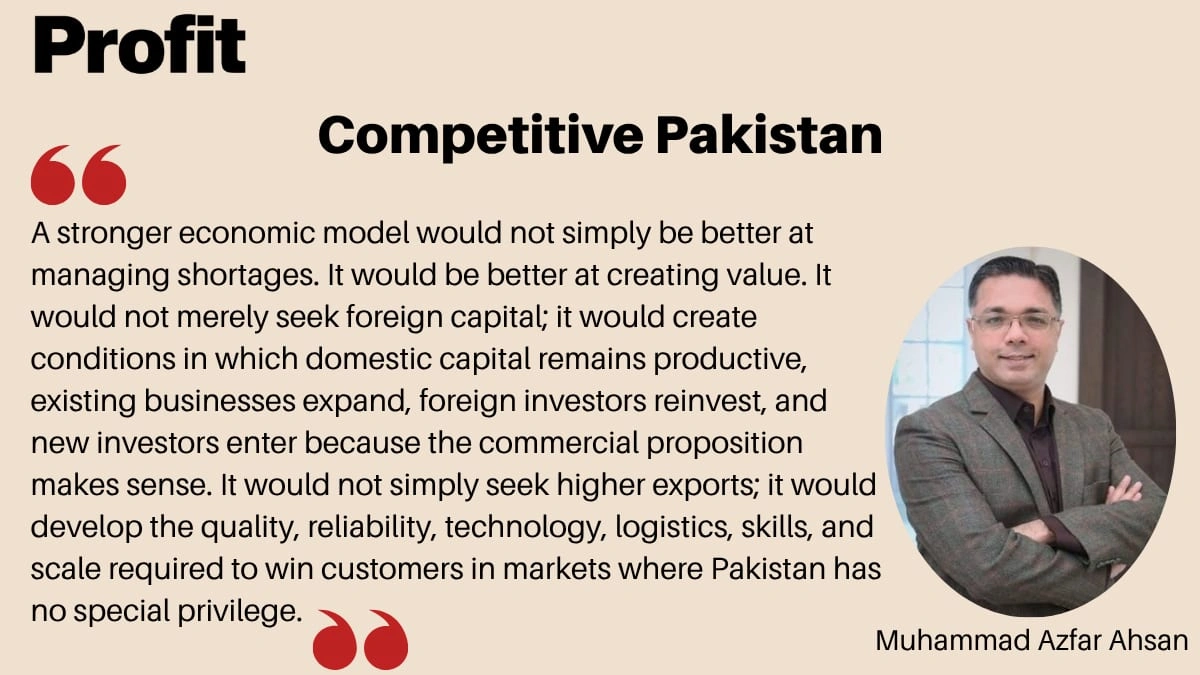
A stronger economic model would not simply be better at managing shortages. It would be better at creating value. It would not merely seek foreign capital; it would create conditions in which domestic capital remains productive, existing businesses expand, foreign investors reinvest, and new investors enter because the commercial proposition makes sense. It would not simply seek higher exports; it would develop the quality, reliability, technology, logistics, skills, and scale required to win customers in markets where Pakistan has no special privilege.
The economic logic is straightforward. A more productive economy creates greater value from its people, capital, resources, infrastructure, and technology. That strengthens businesses, expands exports, attracts capital, creates better jobs, raises incomes, and broadens the fiscal base. The problem is that Pakistan has too often tried to begin at the end. We want investment without sufficiently improving the investment environment, exports without addressing the cost of production, technology without changing the systems around it, and growth without confronting the constraints that make it unstable. The answer begins with something less glamorous but far more consequential: removing friction.
Pakistan’s economy carries a friction tax. It is paid every day through delays, approvals, regulatory uncertainty, unreliable services, complicated procedures, inefficient logistics, inconsistent taxation, and the administrative cost of doing ordinary business. Each obstacle may appear manageable in isolation. Collectively, they make productive activity unnecessarily expensive.
A manufacturer loses time securing approvals. An exporter waits for documentation. An investor struggles to navigate multiple agencies. A business spends resources interpreting regulations rather than expanding. An entrepreneur discovers that the cost of complying with the system can be greater than the cost of producing the product. These are not minor administrative inconveniences. They influence investment decisions, prices, employment, exports, and ultimately economic growth.
The most powerful economic change may therefore be the removal of thousands of small obstacles that collectively make productive activity unnecessarily expensive. This should change the way Pakistan thinks about incentives. The first question should not be what incentive the state can offer. It should be what obstacle the state can remove. Remove friction before offering incentives.
The same principle applies to capital. Pakistan has traditionally measured investment success largely by how much new money enters the country. That is an incomplete measure. The objective should not be to attract capital once. It should be to create an economy in which capital wants to return, expand, and bring others with it.
A serious investment environment is one in which domestic businesses reinvest, foreign investors expand existing operations, successful enterprises attract additional capital, and investors can make commercial decisions without depending on personal access to decision makers. Existing investors should not have to repeatedly rediscover how to operate in Pakistan. Their problems should be resolved through functioning systems, clear processes, predictable taxation, and institutions that understand that their primary responsibility is to facilitate productive activity.
Capital, however, is not an end in itself. It creates prosperity only when it enters an economy capable of deploying it efficiently. That brings us to exports, where the domestic economy meets the unforgiving discipline of the international market.
The international customer owes Pakistan nothing. There is no administrative protection, political access, or guaranteed buyer. A global customer compares price, quality, reliability, delivery time, standards, financing, technology, and after sales service with alternatives from around the world.
The question, therefore, is not simply how Pakistan can export more. The harder and more useful question is: why should a global customer choose Pakistan? The answer cannot permanently be lower wages or lower prices. Competing primarily on low cost is a race Pakistan cannot sustainably win. The country must move from being a low cost economy toward becoming a higher value economy, where specialization, quality, technology, speed, reliability, and knowledge increasingly determine what Pakistani businesses can earn.
Pakistan cannot build lasting prosperity through consumption alone, population growth, currency adjustments, or periodic injections of external financing. Sustainable growth requires producing greater value from land, labor, capital, energy, infrastructure, and technology.
That challenge exists across the economy. Agriculture must generate greater value from scarce water and land. Manufacturing must move toward more sophisticated products. Services must become more technology enabled. Logistics must become faster and more efficient. Financial systems must allocate capital more effectively. The government itself must deliver services with fewer delays and lower transaction costs.
The shift from low cost to high value will not happen through slogans. It requires businesses that invest in technology, managers who improve processes, workers who acquire relevant skills, institutions that reward innovation, and policies that allow productive enterprises to expand.
Technology, particularly artificial intelligence, now gives Pakistan an opportunity to accelerate that transition. AI should not be viewed simply as another technology sector that might generate exports. Its larger significance is that it can transform how the existing economy operates. It can improve agricultural decisions, manufacturing processes, financial services, logistics, education, healthcare, public administration, and thousands of business processes.
Pakistan should not aspire merely to become an AI consuming economy. It should use AI to make the economy it already has more sophisticated, more efficient, and more connected to global markets. But no technology can compensate for weak human capital.
Pakistan’s demographic scale can become an extraordinary economic advantage only if its people are equipped to participate productively in the modern economy. Education, technical training, digital skills, health, workforce participation, entrepreneurship, and access to opportunity are not social concerns sitting outside economic policy. They are part of the country’s economic infrastructure.
The more important question is no longer how many young people Pakistan has. It is what those young people will be able to do. Why should a talented young Pakistani believe that his or her best future can be built in Pakistan? The answer depends on whether the country creates pathways through which knowledge can become enterprise, skills can become income, and ambition can become opportunity. If those pathways remain weak, Pakistan is not merely losing people. It is losing future entrepreneurs, engineers, researchers, managers, exporters, innovators, and taxpayers.
The same transformation is required from the business sector. Pakistan must move from asking what it can produce to asking where it can occupy a valuable position in global value chains. The opportunity is not limited to exporting more textiles or agricultural commodities. It lies in moving upward: processed food rather than raw agricultural output, higher value apparel and technical textiles rather than basic textile products, specialized manufacturing rather than low value assembly, sophisticated digital services rather than low value outsourcing, and downstream mineral processing rather than simply extracting resources.
The objective should be value creation, not merely volume. The regional context makes this transition unavoidable. India, Vietnam, Indonesia, Malaysia, Bangladesh, Saudi Arabia, the United Arab Emirates, and others are pursuing capital, technology, talent, manufacturing, logistics, tourism, and global market access through different models and at different speeds.
Investors compare the time required to establish a business, the reliability of energy, the availability of skilled workers, the cost of logistics, the predictability of taxation, the depth of supply chains, the ease of moving capital, and the reliability of institutions. Talent makes similar calculations about income, opportunity, professional growth, quality of life, and the future of its children. Businesses make decisions based on whether expansion is commercially rational.
Pakistan does not enter this contest only when it chooses to. It is already part of it. That reality should lead to a focused national agenda rather than another long list of disconnected initiatives.
First, Pakistan must become investable through predictability, commercial logic, efficient institutions, and credible rules rather than incentives alone. Second, Pakistani enterprises must become globally capable rather than permanently dependent on domestic protection. Third, exports must become a central measure of economic strength rather than an annual target discussed primarily when foreign exchange is scarce. Fourth, human capital and technology must be treated as productive assets rather than separate policy domains. Fifth, the cost of doing business must become internationally viable, because every unnecessary delay, procedural burden, tariff distortion, unreliable utility, regulatory ambiguity, and avoidable transaction cost ultimately reduces the country’s ability to win in global markets.
These priorities require a longer horizon than the next budget or political cycle. Businesses need time to invest. Workers need time to acquire skills. Institutions need time to improve. Technologies need time to mature. New markets need time to develop. The objective should therefore be a national economic direction that survives changes in government and remains anchored in measurable outcomes.
This does not mean the state should attempt to run the economy. It means the state must create the conditions in which productive activity can flourish. It should own what it must, regulate what it should, and enable everything else to become more productive. The market cannot compensate indefinitely for an inefficient state, and the state cannot create prosperity by substituting itself for the market. The answer lies in getting the boundary right. The state’s job is not to make every economic decision. Its job is to make productive decisions easier, faster, safer, and more predictable.
An economy cannot succeed in global markets if the state surrounding it remains slow, fragmented, unpredictable, and excessively dependent on discretion. Businesses cannot plan when rules constantly shift. Investors cannot calculate returns when approvals are uncertain. Young people cannot plan their futures when education does not connect with opportunity. Exporters cannot win customers when domestic systems impose costs their international competitors do not bear.
The quality of the economy is therefore inseparable from the quality of the state that enables it. Pakistan’s reset should ultimately be measured not simply by whether the economy returns to stability, but by whether it develops the ability to create greater value, participate more deeply in global markets, generate better employment, retain talent, and expand opportunity.
Pakistan does not need to become another country. It needs to become a more capable version of itself: a country that converts geography into connectivity, population into human capital, entrepreneurship into globally capable businesses, resources into value added production, technology into economic opportunity, and strategic relevance into commercial relationships.
For too long, we have asked how Pakistan can attract investors. The more important question is how Pakistan can create an economy in which capital, talent, businesses, technology, and markets have compelling reasons to choose it. The objective is not simply to attract capital, but to create the conditions in which it becomes productive, businesses expand, exports grow, and incomes rise.
The challenge, therefore, is no longer simply to repair Pakistan’s economy. It is to build an economy that can create value, compete internationally, generate opportunity, and sustain its own momentum.
And that brings us back to the state. An economy cannot reach that destination if the machinery around it remains slow, fragmented, unpredictable, and resistant to change. The next phase of Pakistan’s reset must therefore confront not only what the economy needs, but what kind of state is capable of delivering it. That is where the next question begins.
Muhammad Azfar Ahsan is a public policy advocate, business strategist, and former Minister for Investment of Pakistan. He advises leading corporate entities on policy advocacy, strategic communications, investment strategy, and leadership positioning, and writes regularly on the economy, governance, and national development.

MUHAMMAD AZFAR SHAH
Articles