The next move
By Muhammad Azfar Ahsan
Pakistan's real problem, the article argues, isn't a lack of potential but its habit of jumping from crisis to crisis instead of building lasting capacity. Drawing on the Leaders in Islamabad Business Summit, the author proposes five moves: fix institutional foundations (rule of law, predictable taxation, contract enforcement) to build investor and citizen confidence; replace scattered initiatives with a focused national strategy built around a few clear priorities; rebuild state institutions for real delivery and accountability, including local government; make education, private enterprise and exports the true engines of growth; and institutionalize continuity so priorities survive beyond any one government. The piece concludes Pakistan must shift from firefighting to foresight from short-term stabilization to long-term development.
September 21, 2026
Published in The Pakistan Today on September 21, 2026
For years, Pakistan has become remarkably good at answering the wrong question: how do we get through the next crisis? The more important question has remained largely unanswered: how do we build a country that no longer lives from crisis to crisis? We have diagnosed our weaknesses, managed our emergencies, announced our reforms, and repeatedly promised a reset. What Pakistan needs now is not another diagnosis. It needs direction, it needs strategy, and it needs the resolve to see both through. The real question is no longer what is wrong with Pakistan; it is what Pakistan will do next.
This question was at the heart of the 9th Edition of the Leaders in Islamabad Business Summit, held last week under the theme “The Next Move”. The Summit brought together policymakers, diplomats, business leaders, investors, international institutions, technology leaders, and other stakeholders. Across the discussions, one conclusion became increasingly clear: Pakistan does not suffer from a shortage of potential, ideas, talent, or resilience. Its deeper deficit is the ability to convert these assets into sustained national progress.
Our economic conversations have too often been organized around the next crisis – the next financing requirement, fiscal gap, external account pressure, investment announcement, export target, or emergency reform becomes the immediate priority. We solve what is urgent and postpone what is important. Over time, firefighting becomes a governing model.
The pause I argued for earlier was never intended to mean inactivity. It was a call to step back from immediate pressure, examine the country’s architecture, and make choices that can survive beyond the next political or economic cycle. A pause has value only if it produces direction.
The first move is to fix the foundations.
Political stability, policy continuity, rule of law, predictable taxation, contract enforcement, security, merit, and effective administration determine the environment in which an economy functions. Businesses make long term decisions based on predictability, investors price uncertainty, and citizens decide whether to build and invest partly on whether the rules will work tomorrow.
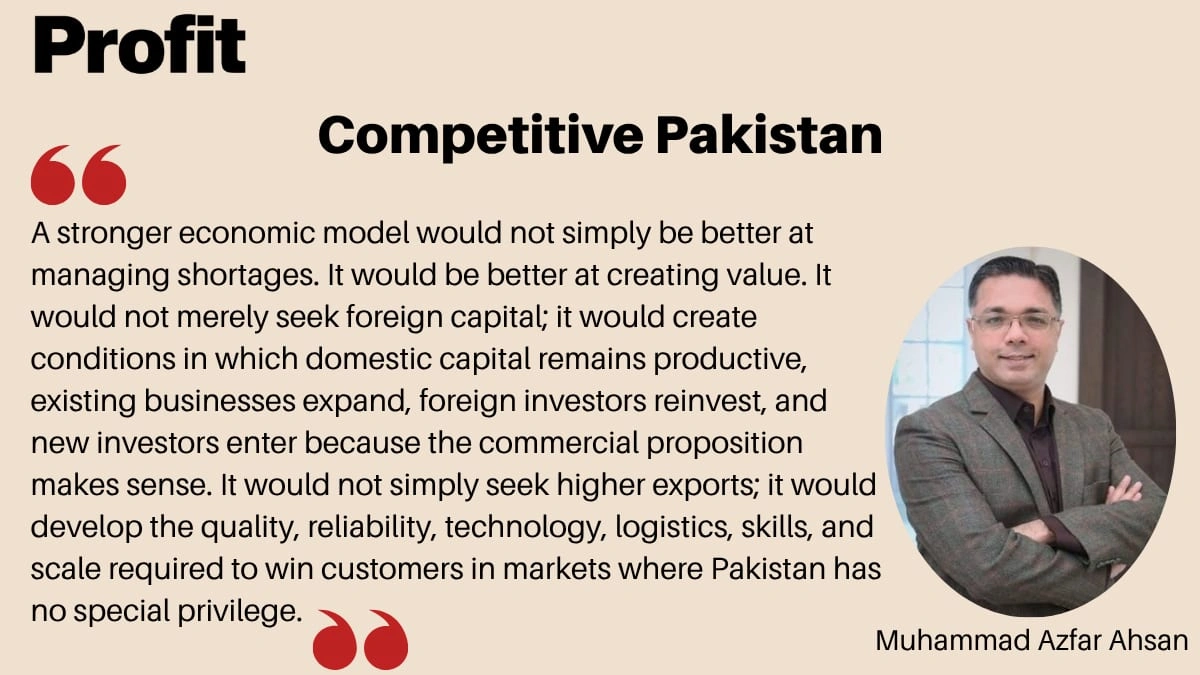
Pakistan cannot build a competitive economy on unpredictable rules. We have spent years asking how to attract foreign capital. The more fundamental question is why an investor should commit capital, remain, reinvest, expand, and encourage others to follow. An investor needs timely approvals, protected contracts, predictable taxation, understandable regulations, functioning infrastructure, credible security, and resolvable disputes. Investment promotion creates visibility; investment infrastructure creates confidence.
The same principle applies to domestic capital. Why should a Pakistani entrepreneur commit capital for the next twenty years to Pakistan? If our own businesses hesitate to expand, modernize, formalize, innovate, or reinvest, that hesitation is itself a measure of economic confidence. A country that cannot persuade its own citizens to invest in its future will struggle to persuade the rest of the world to do so.
Our investment agenda should, therefore, move from promotion to architecture, connecting federal, provincial, and local institutions around the complete investor journey, from entry and facilitation to operations, problem resolution, reinvestment, expansion, and integration into global value chains.
The second move is to build a national strategy rather than another collection of economic initiatives.
Pakistan needs to decide what kind of country it wants to become over the next twenty years. The hierarchy should be clear: national strategy establishes direction, economic strategy provides the engine, sector strategies define priorities, institutions own delivery, and measurable outcomes determine success. Stabilization is necessary. Stabilization is not development!
A functioning economy must generate productive investment, productivity, exports, employment, innovation, and fiscal capacity. Pakistan, therefore, needs an economic strategy connecting fiscal discipline with investment, exports, energy, infrastructure, technology, human capital, and productivity.
But strategy must also be selective. A country cannot execute one hundred priorities simultaneously. Pakistan should identify a limited number of national priorities for the next decade and concentrate political attention, institutional resources, and public accountability around them.
Those priorities should include macroeconomic stability, investment, exports, energy, human capital, education and skills, technology and artificial intelligence, agriculture and food security, infrastructure and connectivity, and state reform. Each priority must have one accountable institutional owner, a defined timeline, measurable outcomes, and a mechanism for public review.
The third move is to rebuild the state for delivery.
We are a country of nearly 260 million people operating in an environment transformed by technology, demographics, economics, geopolitics, and business. Yet many institutions still operate through overlapping mandates, outdated processes, administrative layers, and insufficient specialization.
We do not necessarily need more institutions; we need institutions that work. Every ministry and public body should answer four questions: What outcome is it responsible for delivering? What authority does it possess? How will results be measured? Who is accountable when it fails?
This requires professional leadership, subject expertise, digital systems, coordination, results management, and merit. Reform is not about redrawing organizational charts; it is about making the state capable of timely decisions and delivery.
Local governments must be part of this restructuring. Citizens do not experience the state primarily through Islamabad; they experience it through schools, hospitals, roads, sanitation, water, transport, policing, land administration, and municipal services across all districts. An effective state, therefore, requires empowered, financially viable, and accountable local institutions.
The fourth move is to make people and enterprise the engine of growth.
Pakistan cannot aspire to become a competitive economy while millions of children remain outside quality education. The often-cited figure of approximately 29 million out-of-school children is not simply an education statistic; it is a warning about the country’s productive capacity two decades from now.
Education reform must, therefore, be treated as economic policy. The challenges are learning, teachers, technology, vocational training, employability, and the connection between education and a changing economy.
The government cannot create prosperity by itself; the private sector must be at the center. Businesses must invest, innovate, formalize, improve productivity, develop talent, adopt technology, enter global value chains, and compete internationally. Business organizations should become active partners in improving competitiveness and shaping practical reforms.
We also need to make Pakistan competitive rather than merely active. Exports must become a central pillar of national economic strategy. Competitiveness of export cannot be created through incentives alone. A globally competitive business requires reliable energy, efficient logistics, access to finance, skilled people, technology, predictable taxation, competitive regulation, and the ability to meet international standards.
Agriculture needs productivity, storage, processing, technology, and market access. Manufacturing needs modernization, scale, quality, and global value chains. Services need digital infrastructure, skills, regulatory flexibility, and international markets. Artificial intelligence and digital transformation should become economy wide productivity tools. But technology cannot rescue broken systems. Digitizing an inefficient process merely creates digital inefficiency. We must simplify before we digitize.
The fifth move is to institutionalize continuity.
The real test of a national strategy is whether the country can continue implementing it after the government that launched it is gone. Governments will change; political competition will continue – that is the nature of democracy. But national priorities should not be reset every few years. Pakistan needs a mechanism for setting long-term priorities, monitoring implementation, measuring outcomes, and maintaining direction across political cycles.
This is ultimately a leadership question. Leadership is not the ability to announce another initiative. It is the discipline to establish a direction, make difficult choices, resist short-term pressures, empower competent institutions, and measure success through outcomes rather than announcements.
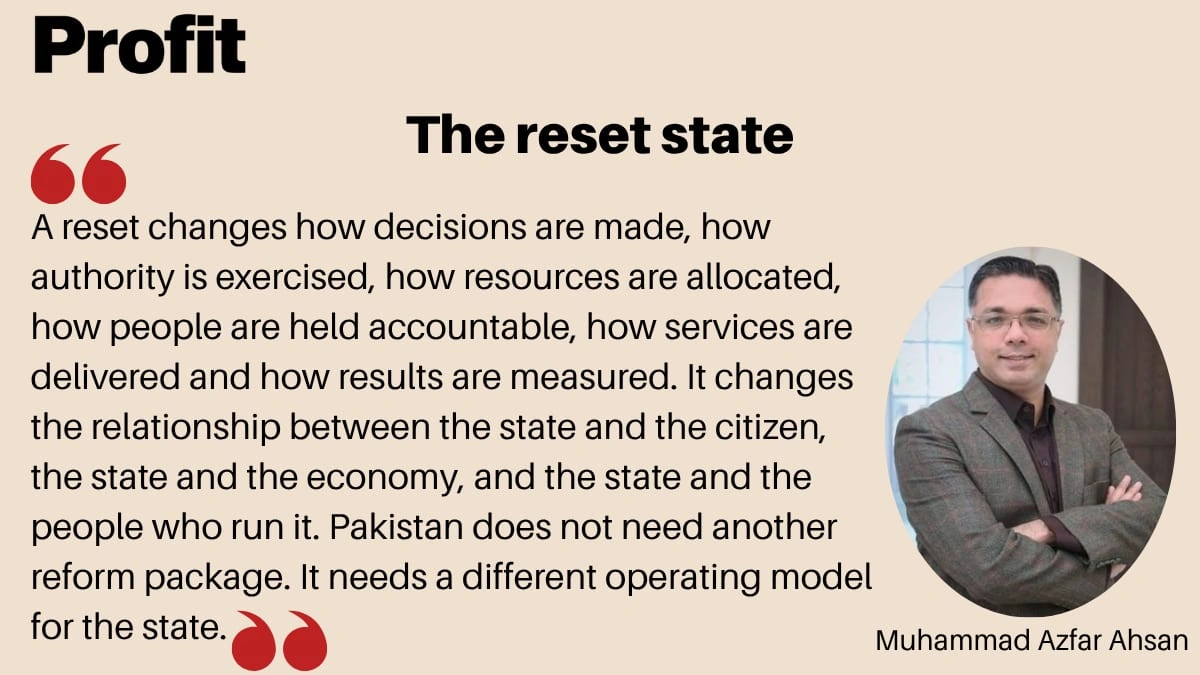
But there is an even deeper question. Pakistan’s problem is not merely that the state is weak; it is that the relationship between the state, the citizen, and the economy has not been redesigned for the Pakistan of today. A state earns legitimacy because citizens experience it as fair, predictable, and capable. A citizen should not need influence to obtain a lawful service. A business should not require personal access for routine approvals. Justice should not depend on social standing.
The state must become more enabling. Its purpose is not to regulate every aspect of economic and social life, but to provide the foundations within which citizens and markets can perform: security, justice, infrastructure, human capital, fair regulation, competition, and predictable rules.
The state should own what it must, regulate what it should, and enable everything else to become more productive. This is a new state-citizen compact. Citizens need security, justice, basic services, equal treatment, and economic opportunity. The state, in turn, needs citizens and businesses that comply with the law, contribute through taxation, invest, innovate, and participate productively in the economy. This compact must become the foundation of the reset.
There is also a hard truth that we must confront. Pakistan does not have the luxury of spending another decade experimenting with short term fixes. Every year of uncertainty carries a cost: capital that is not invested, businesses that do not expand, young people who do not acquire skills, exports that are not created, and institutions that become harder to reform. The cost of delay is not measured only in lost growth. It is measured in lost opportunity.
The global order is changing. Geopolitical competition increasingly influences trade, technology, investment, energy, supply chains, and strategic partnerships, while competition for capital, talent, markets, and technology intensifies.
Pakistan has geography, strategic relevance, a large domestic market, and important international relationships. But strategic relevance alone does not create economic prosperity. We must convert geopolitical relevance into geoeconomic opportunity.
Trade corridors must produce trade; strategic relationships must produce investment; connectivity must produce exports; technology partnerships must produce capabilities; and diplomacy must open markets. Foreign policy and economic strategy, therefore, cannot operate as separate conversations. Pakistan’s international relationships should increasingly be connected to investment, trade, technology, energy, skills, connectivity, and market access.
But there is an essential condition. Before asking the world to invest more in Pakistan, we must make Pakistan more investable. Before asking global companies to trust our institutions, we must strengthen confidence among our own businesses and citizens.
Pakistan does not need another decade of managing symptoms. It needs a decade of building capacity, expanding opportunity, and delivering measurable results. The next move should, therefore, be a national course correction: from firefighting to foresight, from ad hocism to strategy, from announcements to execution, from discretion to predictable rules, from dependence to competitiveness, and from short term stabilization to long term development.
Pakistan has survived crisis after crisis because its people have repeatedly found the resilience to endure what its systems have failed to prevent. But resilience cannot remain a national strategy. A country cannot build its future by continually preparing for the next emergency. At some point, survival must give way to construction, reaction must give way to strategy, and potential must be converted into performance.
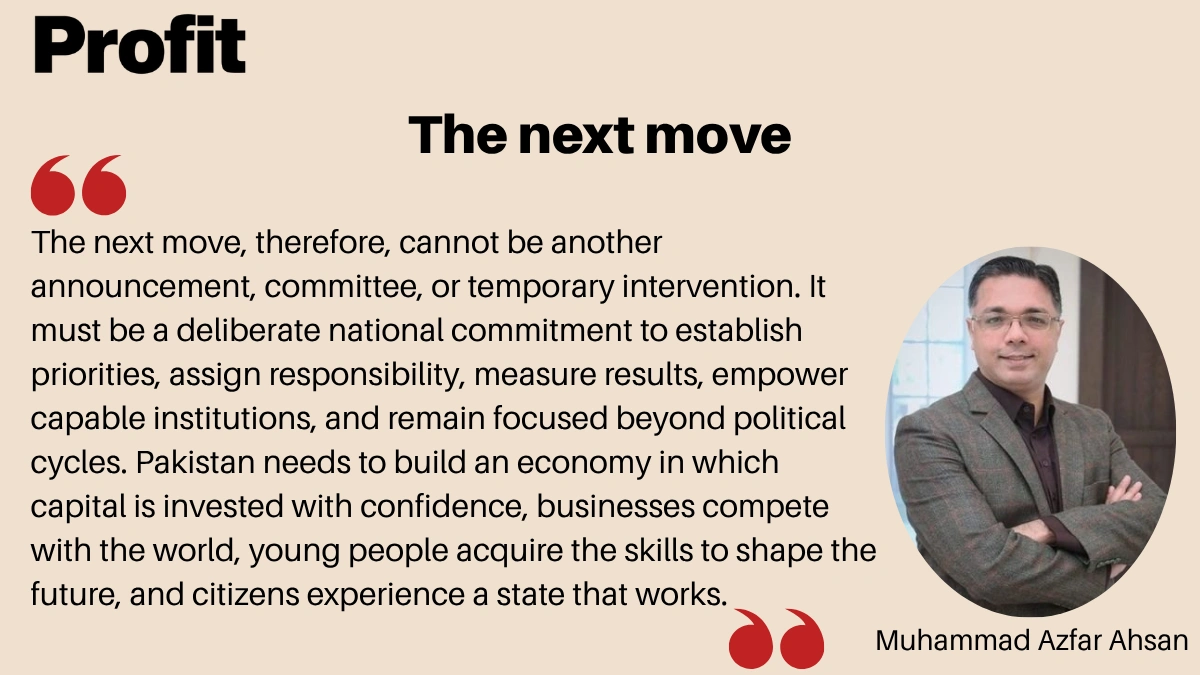
The next move, therefore, cannot be another announcement, committee, or temporary intervention. It must be a deliberate national commitment to establish priorities, assign responsibility, measure results, empower capable institutions, and remain focused beyond political cycles. Pakistan needs to build an economy in which capital is invested with confidence, businesses compete with the world, young people acquire the skills to shape the future, and citizens experience a state that works.
We already know much about what must be done. The challenge now is to summon the courage to act, the clarity to remain focused, and the accountability to measure whether it is working. The choice is no longer between one reform and another. It is between continuing to manage recurring crises and building the capacity to prevent them.
History will not ultimately remember how many crises Pakistan managed or how many plans it announced. It will remember whether, when the country reached a moment that demanded a decisive change of course, its leaders and institutions had the wisdom to choose a national direction, the courage to stay the course, and the discipline to transform Pakistan’s extraordinary potential into a stronger, more prosperous future for generations yet to come.
Muhammad Azfar Ahsan is a public policy advocate, business strategist, and former Minister for Investment of Pakistan. He advises leading corporate entities on policy advocacy, strategic communications, investment strategy, and leadership positioning, and writes regularly on the economy, governance, and national development.

MUHAMMAD AZFAR SHAH
Articles