The Leadership Question
By Muhammad Azfar Ahsan
This piece argues that Pakistan's core problem isn't a shortage of talent or resources, but a shortage of leadership that builds beyond itself. Progress in the country has too often depended on individual personalities rather than durable institutions so when a capable official transfers or a leader leaves office, the gains disappear with them. Drawing on examples like Sir Ganga Ram, Dr. Ruth Pfau, Dr. Adibul Hasan Rizvi, and Syed Babar Ali, the author contrasts short-term "firefighting" governance with true nation-building leadership: developing people, creating institutions, and establishing systems that outlast any single tenure. The piece calls on political leaders, civil servants, and business leaders alike to think beyond election cycles, transfers, and quarterly results measuring success not by personal control or achievement, but by what continues to function and serve citizens after they're gone. Real national progress, it concludes, is cumulative and generational, not personality-driven.
September 10, 2026
Published in The Pakistan Today on September 10, 2026
The destiny of nations is not determined merely by what they possess, but by what their leaders are able to build from what they possess. Resources can remain idle, talent can remain scattered, and ideas can remain trapped in speeches, reports, and promises. It is leadership that determines whether these advantages are organized into national strength, translated into progress, and carried forward beyond the individuals and governments of a particular moment.
Pakistan’s tragedy is not that it lacks potential. Its greater failure has been the repeated inability to convert extraordinary potential into sustained national progress. The country has produced exceptional individuals, accumulated immense human talent, and possessed every ingredient necessary for advancement. Yet too often, progress has remained dependent on personalities rather than becoming embedded in the national frameworks that can preserve success, multiply it, and carry it across generations.
That failure sits beneath many of Pakistan’s visible problems. We debate economic instability, weak governance, declining state performance, low investment, unemployment, poor public services, policy inconsistency, and the country’s recurring inability to convert extraordinary potential into sustained progress – each deserves serious attention. Yet beneath them lies a more consequential question: what kind of leadership can transform a nation’s potential into lasting national progress and ensure that what is built does not disappear when the individual, government, or political cycle changes?
Pakistan has never lacked talented individuals. It has produced exceptional public servants, entrepreneurs, professionals, academics, philanthropists, political leaders, and builders of lasting organizations. Individual excellence has never been the country’s principal shortage. The deeper deficiency is the absence of a sufficiently strong culture of leadership that consistently thinks beyond the immediate crisis, beyond personal tenure, and beyond the lifetime of the individual exercising authority.
Too often, we confuse authority with leadership, activity with achievement, and personal success with lasting contribution. Leaders are frequently judged by the offices they occupy, the announcements they make, the projects they inaugurate, or the visibility they command while in power. We ask what they achieved during their tenure, but far less often ask what remained stronger and more effective because they were there.
That distinction goes to the heart of Pakistan’s development challenge. An individual can solve a problem, but a well-structured and resilient organization can continue solving it across generations. A capable leader can deliver results while occupying a position, but sound arrangements can continue producing results after that leader has departed. The highest form of leadership, therefore, is not simply the ability to perform personally. It is the ability to develop people, build enduring organizations, establish effective processes, and create strengths that outlast the individual who created them.
Pakistan has gradually become accustomed to operating within short horizons. Politics revolves around electoral cycles, governments work within annual budgets and immediate political pressures, public officials operate amid uncertain transfers and changing mandates, businesses face immediate commercial demands, and public discourse increasingly follows the urgency of the news cycle. Together, these pressures create a national condition in which the immediate repeatedly overwhelms the important.
The consequences are visible throughout governance. Firefighting replaces strategy, emergency intervention substitutes for preparation, and temporary relief becomes easier to deliver than structural reform. We respond to crises after they become unavoidable rather than preparing to reduce their likelihood. We manage consequences while postponing the more difficult work of correcting underlying causes.
This is not merely inefficient policymaking. It reflects a failure to think of Pakistan as a long-term national project. Ad hocism is, therefore, more than a policy problem; it is often a failure of leadership imagination. A country cannot build a stronger future if those responsible for its direction remain permanently occupied with surviving the present. National leadership requires the ability to manage immediate pressures while laying the foundations that will reduce future crises.
The essential question should, therefore, be straightforward: what must be built now for Pakistan to become more capable ten, twenty, and thirty years from today?
That question changes how leadership should be understood. Every person entrusted with responsibility, whether in government, business, academia, civil society, or public life, should eventually confront a test larger than personal achievement: Did the organization entrusted to me become stronger because I led it? Did it become less dependent on personal influence? Were capable people developed and entrusted with greater responsibility? Were effective processes created that could survive changes in leadership? Did those who followed inherit stronger foundations than those who came before?
These questions distinguish achievement from legacy.
Pakistan’s history provides important examples of leadership that understood this difference. In working on my recent book, “Syed Babar Ali: A Centennial Tribute,” I was repeatedly reminded of how leaders can shape society across generations despite the red tape, barriers, and limitations that have long constrained progress in Pakistan. Their significance lies not merely in what they achieved personally, but in what they continued to make possible for others.
Sir Ganga Ram’s contribution to Lahore was not simply a collection of buildings or engineering projects. His work helped shape civic infrastructure and public organizations whose purpose extended far beyond the life of their creator. Dr. Ruth Pfau demonstrated another dimension of enduring leadership by transforming moral conviction into an organized national response to leprosy, proving that sustained professional effort can change what once appeared to be an unavoidable national condition.
Dr. Adibul Hasan Rizvi built an organization around an equally powerful principle: that dignity and quality should not depend on a citizen’s ability to pay. The Sindh Institute of Urology and Transplantation demonstrated what becomes possible when competence, professional standards, research, education, and public purpose reinforce one another over time. Syed Babar Ali represents another model of long-term nation-building through his contributions to industry, education, environmental stewardship, philanthropy, and civic life.
The larger lesson from these four individuals is not simply the scale of their personal achievement. Their work reflected vision, values, discipline of execution, and a form of leadership directed toward something larger than themselves. Their contributions reached ordinary people and continued across generations because they built with purpose rather than merely pursuing prominence. National progress is cumulative: capable people strengthen organizations, effective organizations create opportunity, and continuity allows progress to compound over time.
That combination of vision, values, discipline, and selfless leadership is precisely what appears increasingly absent from too many of Pakistan’s power corridors and, more broadly, from leadership across different walks of life. The defining question is not simply what a leader accomplishes personally, but what becomes possible for others because of what that leader builds.
This is particularly relevant because too much of Pakistan’s public performance remains dependent on individuals. A capable public official arrives and a department begins functioning better, only for momentum to disappear after a transfer. A visionary head transforms an organization, but succession is neglected and performance weakens after the leader departs. Government changes, and policies are abandoned not because they failed, but because they are associated with a previous administration. A reform begins with energy but loses direction when its original sponsor leaves office.
This is not lasting national strength; it is dependence on personalities.
A mature organization should not require a permanent savior. Its professional culture, accumulated knowledge, operating practices, internal competence, and accountability mechanisms should enable it to function through changes in leadership. The ultimate test is not whether an organization performs while a particular individual is present, but whether it can continue performing effectively after that individual is gone.
That requires a fundamentally different understanding of power. Too often, leadership is associated with control over decisions, information, access, and people. Organizations gradually become dependent on those at the top, and indispensability is mistaken for effectiveness. The alternative requires delegation, professionalization, succession planning, clear responsibilities, distributed authority, and the confidence to develop people who may eventually become more capable than the individual who trained or appointed them.
The strongest leaders do not measure their importance by how indispensable they become. They measure their success by how effectively people and organizations can perform without them.
This principle applies across the state and society. Political leadership must think beyond the next election and establish national priorities capable of surviving changes in government. Pakistan cannot make sustained progress if every political transition produces disruption, policy reversal, and the abandonment of accumulated experience. Governments have every right to pursue different mandates, but a country cannot afford to rebuild its foundations every time political leadership changes. There must be a distinction between political choice and the destruction of professional continuity.
The civil service carries an equally important responsibility. Public servants should not see themselves merely as administrators of files, procedures, and immediate instructions. They are custodians of continuity within the state. Their responsibility extends beyond managing the present to strengthening the professional foundations they hand over to those who follow. That requires clear mandates, relevant expertise, measurable performance, professional autonomy, and sufficient continuity for capable officials to complete meaningful work.
The same principle applies to business leadership. The private sector is not merely a collection of companies competing for market share; it is one of the principal mechanisms through which a country creates investment, employment, technology, innovation, skills, exports, and economic strength. Businesses focused exclusively on immediate commercial returns may build successful enterprises. Those that invest in people, research, technology, professional standards, supply chains, governance, and broader business ecosystems contribute to something larger: national competitiveness.
Countries do not become competitive merely because individual companies become profitable. They become competitive when businesses collectively raise productivity, develop skills, strengthen supply chains, build technological depth, and connect domestic talent to global markets. The same principle extends to universities, philanthropies, professional associations, and civil society. Their purpose cannot simply be to operate successfully in the present; they must prepare society for the demands of the future.
At the center of this argument is a simple principle: leadership should expand the capacity of others. A leader’s greatest contribution is often not what he or she accomplishes personally, but the environment created for others to accomplish more. Good leadership reduces unnecessary barriers, rewards merit, creates access, develops talent, distributes responsibility, and establishes conditions in which capable people can succeed without extraordinary personal connections.
This principle is particularly important for Pakistan because a country becomes stronger when its governance architecture reduces the importance of privilege. Transparency makes influence less necessary. Professional environments allow merit to travel further than personal relationships. Predictable regulation enables enterprise, while a dependable state allows citizens to devote more energy to building businesses, careers, families, and communities rather than navigating institutional uncertainty.
Ultimately, leadership must be judged by its consequences for ordinary citizens. The purpose of effective public and private organizations is not to create impressive organizational charts or additional layers of administration. It is to expand the possibilities available to people. When a child receives an education that genuinely expands his or her future, when a patient receives treatment with dignity, when a young person acquires skills connected to productive employment, when an entrepreneur can establish a business without arbitrary obstruction, and when a citizen can obtain a legitimate public service without seeking a favor, good governance becomes a lived reality.
Pakistan’s persistent weakness has been its tendency to address symptoms while leaving foundations unchanged. We launch initiatives, announce packages, establish committees, and create task forces in response to immediate pressure, yet often fail to ask why the same problems continue returning. Why does a crisis recur? What structural weakness produced it? What is missing? Where does responsibility become fragmented? What must change, and what must be built now so that the next generation does not inherit the same problem?
These are leadership questions. The difference between firefighting and nation-building lies in the willingness to ask them and then in the discipline to act on the answers. Firefighting will always be necessary because governments cannot ignore immediate crises or ask vulnerable citizens to wait indefinitely while long-term reforms mature. But emergency intervention cannot become the permanent model of national management. Serious leadership must be capable of doing both: managing today’s crisis while building tomorrow’s resilience.
That requires patience, a quality increasingly undervalued in public life. The most consequential investments rarely produce immediate political or personal rewards. Education takes years to translate into national strength. Reform may initially be invisible. Research, technology, and innovation require long horizons before their full value becomes apparent. Professional cultures cannot be built through announcements, and progress cannot be measured solely by what happens within a single tenure. Countries are built through the accumulation of disciplined decisions over time.
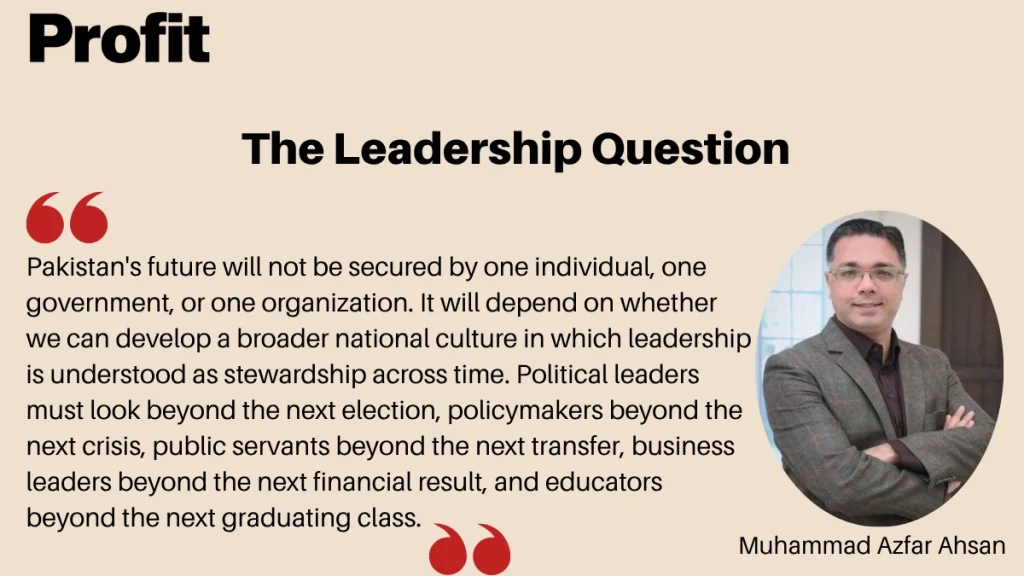
Pakistan’s future will, therefore, not be secured by one individual, one government, or one organization. It will depend on whether we can develop a broader national culture in which leadership is understood as stewardship across time. Political leaders must look beyond the next election, policymakers beyond the next crisis, public servants beyond the next transfer, business leaders beyond the next financial result, and educators beyond the next graduating class.
This is not an argument against ambition. Ambition has built companies, organizations, careers, and nations. The question is what ambition ultimately serves. Personal ambition can create individual success; larger ambition can create collective progress. Pakistan needs more of the latter.
The country does not merely need people capable of exercising authority. It needs people capable of converting authority into lasting national progress. It does not merely need successful individuals. It needs leaders who can transform individual success into collective progress and prevent today’s recurring problems from becoming permanent national conditions.
Pakistan’s next phase of development will depend on whether those entrusted with influence and responsibility are prepared to think beyond themselves. A nation moves forward when its leaders measure success not by how much they control, but by what they make possible for others; not by how long they remain important, but by what continues to serve the country after they are gone.
That is the legacy test of leadership. A position gives a person authority, and achievement may bring recognition. But authority is temporary, recognition fades, and every individual eventually leaves the stage. What endures is what they build, the people they develop, and the foundations they leave behind for the nation.
Pakistan has never lacked talent, ambition, resources, or ideas. Its defining question is whether those entrusted with leadership will finally convert that potential into progress strong enough to survive political cycles, institutional transitions, and individual ambitions. Because Pakistan’s future will not be secured by those who merely lead for their time, but by those who build for generations they may never live to see.
Muhammad Azfar Ahsan is a public policy advocate, business strategist, and former Minister for Investment of Pakistan. He advises leading corporate entities on policy advocacy, strategic communications, investment strategy, and leadership positioning, and writes regularly on the economy, governance, and national development.

MUHAMMAD AZFAR SHAH
Articles