The State must deliver
By Muhammad Azfar Ahsan
This blog argues that a state earns legitimacy not by existing, but by delivering through the school, hospital, police station, and courtroom a citizen actually encounters. Pakistan's real governance problem, it says, is the widening gap between what citizens are promised and what they experience, pushing people toward costly private alternatives and creating an invisible "institutional tax" on the economy. The piece calls for a shift from activity-driven to outcome-driven governance: empowered local government, timely justice, a merit-based civil service, and technology that removes friction instead of digitizing dysfunction. Its core message is that trust, not mere presence, is what makes a state dependable and that economic growth cannot outlast weak institutions.
August 24, 2026
Published in The Pakistan Today on August 24, 2026

A state does not earn legitimacy because it exists. It earns legitimacy when citizens can feel that it works. For the ordinary citizen, the state is not an abstract constitutional arrangement, a ministry, a policy document or a budget speech. It is the school that teaches or fails to teach, the hospital that treats or turns illness into anxiety, the police station where protection is sought, the court where justice is awaited, the municipal service that determines whether a neighborhood is livable, and the public office where a business owner discovers whether the state is a facilitator or an obstacle. These everyday encounters are where the authority of the state acquires meaning.
This is where the social contract becomes real. Pakistan has spent decades debating the size, structure and capacity of the state. We have created institutions, commissions, authorities and reform programs, often with good intentions and considerable effort. Yet the more fundamental question remains: what does a citizen receive in return for the obligations imposed by the state?
Citizens pay taxes, obey laws, work, invest, educate their children and contribute to society. In return, they expect security, justice, education, healthcare, infrastructure, opportunity, and fair treatment. When these expectations are repeatedly unmet, dissatisfaction becomes something more consequential. Trust erodes, compliance weakens, and citizens begin to construct private substitutes for public systems.
Those who can afford it purchase private education, healthcare, security, transport, and utilities. They increasingly seek private mechanisms to resolve problems that should be addressed through public institutions. The state remains formally present, yet citizens increasingly learn to navigate around it rather than rely on it.
A functioning state does not make citizens dependent upon its bureaucracy; it gives them confidence that its institutions will perform their essential functions fairly, predictably, and without requiring personal influence.
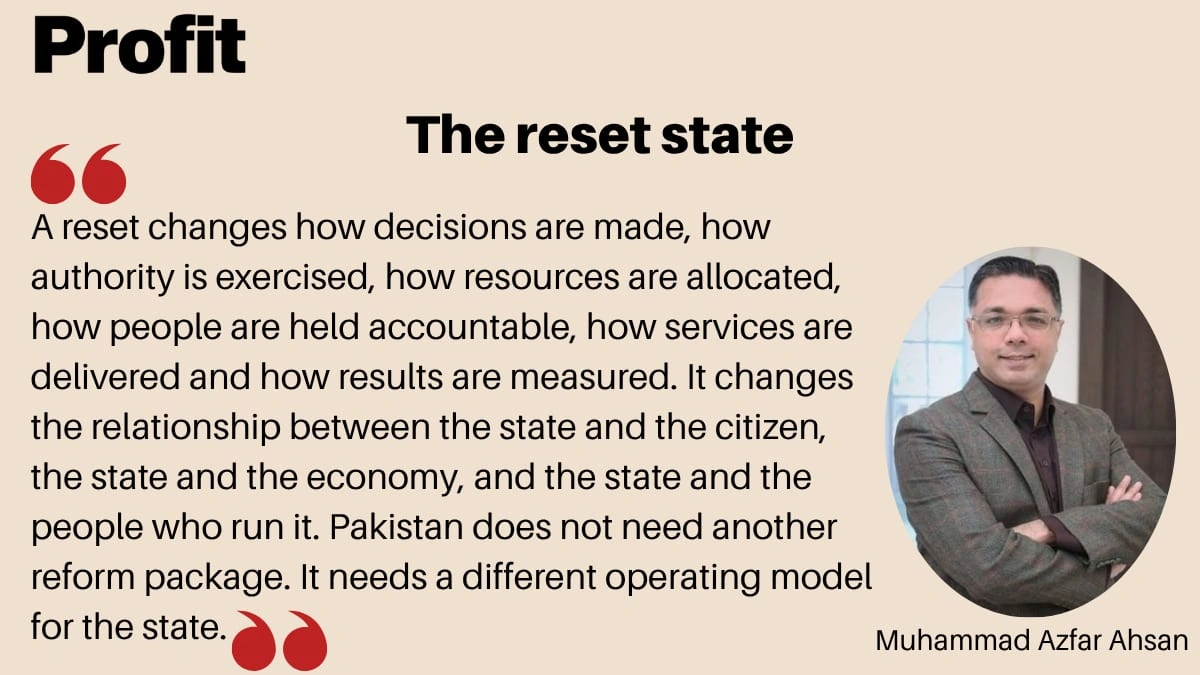
Pakistan, therefore, does not simply need more government. It needs a more capable state: one that knows where its presence is essential, where it should step back and where institutional capacity can create the greatest public value. The question is not how much the state does, but how well it performs the responsibilities that only the state can discharge.
A capable state performs its essential responsibilities reliably, allocates resources intelligently, protects citizens equally, and creates conditions in which individuals and businesses can build better lives. Its strength should be measured not by the number of departments it controls, regulations it issues or meetings it holds, but by the outcomes citizens experience.
The citizen must become the ultimate unit of measurement.
This is why public service delivery is ultimately a question of legitimacy. A citizen should not need influence or connections to obtain something the law already entitles them to receive. A business should not need personal access to secure an approval that ought to move through a transparent system. A patient should not need a privileged connection to receive timely care, and a student should not require a privileged family background to access quality education. Justice should not depend on social standing.
When access to public services becomes dependent on privilege, the state ceases to be experienced as equal. Citizens begin to distinguish between the state they are promised and the state they actually encounter. The result is not merely frustration; it is a loss of dignity. A citizen should be able to approach an institution as a rights-bearing member of society, not as someone seeking a favor.
That gap between entitlement and experience is one of Pakistan’s deepest governance problems, and it carries a significant economic cost. When public systems fail, citizens and businesses purchase private alternatives, absorb higher transaction costs, delay decisions, and devote resources to navigating bureaucracy rather than creating value. Weak institutions, therefore, impose an invisible institutional tax on the economy. They reduce productivity, discourage investment, constrain social mobility, and make economic growth more expensive.
The answer is not another institutional rearrangement without a corresponding change in performance. Every major institution should know what it exists to deliver, whom it serves, how performance will be measured, and who is accountable when outcomes fall short. Government must become outcome oriented.
A ministry should not be judged primarily by the number of meetings it holds, notifications it issues or schemes it announces. It should be judged by whether the problem within its mandate is becoming smaller. Health departments should be measured by health outcomes, education departments by learning, police by public safety, and confidence in the law, and municipal governments by the quality of services citizens receive where they live. Public expenditure should be judged not simply by what is spent, but by what capability that expenditure creates.
This requires a fundamental administrative shift: from activity to outcomes, from discretion to systems, from hierarchy to responsibility, and from announcements to measurable delivery. It also requires designing government from the citizen’s experience backwards rather than from the bureaucracy’s structure forwards. The citizen should not have to understand which department, authority or tier of government is responsible for solving a problem. That is the state’s problem, not the citizen’s.
Local government is indispensable.
Citizens do not experience the state primarily in Islamabad or provincial capitals. They experience it where they live. Roads, drainage, waste management, water supply, public transport, local planning, parks, building permissions, and many everyday services are fundamentally local. Yet Pakistan has repeatedly struggled to create empowered, financially viable, and accountable local governments capable of performing these functions.
A strong federation cannot be built on weak local institutions. Local governments need defined responsibilities, predictable resources, professional capacity, and clear accountability to the citizens they serve. Decentralization without capacity is ineffective, but centralization without local responsiveness is equally damaging. Decisions should be placed as close as practical to citizens while national standards, fiscal discipline, and accountability remain intact. Local government is not an intermittent political arrangement; it is part of the basic architecture through which citizens experience the state.
The same principle applies to justice. Justice delayed is not merely a legal inconvenience. It changes economic behavior, weakens investment confidence, raises the cost of doing business, and teaches citizens that formal institutions may not protect their interests. Businesses cannot make long-term commitments when contracts are difficult to enforce. Families cannot plan confidently when property disputes remain unresolved for years. Citizens cannot develop institutional trust when access to justice appears unequal.
Judicial reform, therefore, belongs within the architecture of economic and social development. Courts need capacity, technology, procedural efficiency, and disciplined case management. Commercial disputes require mechanisms capable of producing timely and credible outcomes, while alternative dispute resolution should be strengthened where appropriate. Most importantly, citizens must believe that the law is not merely written but enforceable.
The same standard must apply to the civil service
Pakistan does not lack capable public servants. It lacks a system that consistently enables capable people to perform, rewards results, and protects professionalism while holding failure accountable. Frequent transfers, unclear mandates, political disruption, and weak performance management can turn competent officials into administrators of process rather than leaders of delivery.
A professional civil service requires clear roles, continuity in critical positions, relevant expertise, and measurable performance. Officials need sufficient authority to execute their mandates, matched by responsibility for outcomes. Political leadership should establish direction and priorities without repeatedly disrupting the machinery required to implement them. Merit must matter not only at recruitment, but throughout a public servant’s career. Competence should determine responsibility, performance should influence progression and integrity should remain non-negotiable.
Institutional continuity matters because public institutions must outlast governments. A new administration may legitimately change priorities, but it should not have to rebuild institutional memory, reverse established systems or disrupt capable teams every time political leadership changes. Policy can evolve without the state having to start again.
Accountability must reinforce this architecture, not undermine it. A state that cannot measure performance cannot manage it. Major public institutions should have a limited number of clearly defined priorities, measurable indicators, and transparent reporting mechanisms. Performance evaluation should be connected to outcomes rather than seniority or procedural compliance.
But accountability must not become selective pressure. It must be predictable, transparent, and governed by rules. When accountability is perceived as arbitrary, it produces fear rather than performance. Public servants become more concerned with avoiding decisions than making them, and administrative paralysis follows. The purpose of accountability should be to improve institutions, correct failures, and protect public resources, not merely to produce headlines.
Creating equal opportunities
Equality does not mean identical outcomes. It means that a person’s prospects should not be determined overwhelmingly by the circumstances of birth. A child from a low-income family should have a genuine pathway to quality education. A talented young person should be able to acquire skills connected to employment. A small entrepreneur should be able to enter markets without political access. A woman seeking economic participation should not face unnecessary institutional barriers. A citizen in a smaller city should not be condemned to inferior public services because of geography.
A society can tolerate differences in wealth more easily when people believe that effort, education, ability, and enterprise can change their circumstances. It becomes far more fragile when advantage reproduces itself across generations while opportunity narrows for everyone else. A healthy social contract does not promise equal outcomes; it creates credible pathways through which merit, effort, and enterprise can improve outcomes.
Pakistan’s young population, therefore, represents both an extraordinary opportunity and a profound responsibility. Demography does not automatically produce a dividend. Young people become an economic asset when they possess knowledge, health, skills, confidence, and access to productive work. Without these, a large youth population can become a source of frustration rather than national strength.
Education must consequently be understood as both economic and social infrastructure. The question is no longer simply how many children are enrolled. It is whether they are learning, whether teachers are equipped, whether curricula develop critical thinking and practical skills, whether technical education responds to industry, and whether universities connect with a changing economy.
Pakistan cannot build a competitive economy while millions of children remain outside quality education. Nor can it build a cohesive society when the quality of education is determined largely by household income. Education is not simply a service the state provides; it is the mechanism through which a society expands capability across generations and gives merit a genuine opportunity to overcome inherited disadvantage.
Healthcare presents the same challenge. A productive society depends on healthy citizens, yet access to quality healthcare remains deeply unequal. Public health policy must move beyond hospitals towards prevention, primary care, maternal and child health, nutrition, and early intervention. Healthcare is not merely a welfare obligation. It is an investment in human capability and national productivity.
These responsibilities cannot be discharged by the government alone. The private sector is Pakistan’s principal source of investment, employment, innovation, and enterprise. It should not replace the state, but neither should it be treated merely as a source of taxation. A productive relationship requires predictable rules, competitive markets, efficient regulation, and a shared understanding that growth expands the resources available for social development.
Corporate Pakistan can contribute to skills, research, innovation, healthcare, education, and community development. But corporate responsibility should complement public responsibility, not substitute for it. The state must remain accountable for public goods that only the state can reliably provide. A strong private sector and a capable state are not competing propositions; each strengthens the conditions in which the other can perform.
Civil society has an equally important role. Non-governmental organizations, professional associations, philanthropies, universities, community organizations, and citizens’ groups often understand local problems better than distant institutions. They can experiment, mobilize resources, identify gaps, and hold institutions accountable. Government should create space for responsible civic participation rather than viewing independent civil society merely through an administrative lens.
The strongest societies are not those in which the government does everything. They are those in which the government performs its essential functions well while citizens, businesses, and civil society contribute their capabilities.
Tech has a role to play
Digital governance should not simply mean putting existing forms online. It should redesign the citizens’ interaction with the state. A citizen should not have to understand the internal structure of government to obtain a public service. Where legally appropriate, data should be moved between departments rather than forcing citizens to repeatedly provide information the state already possesses. Applications should be trackable, timelines visible, and grievances capable of escalation.
But digitization must follow institutional reform. A bad process placed on a digital platform remains a bad process. Technology should remove friction, reduce discretion, improve transparency, and make performance measurable. The objective is not to make bureaucracy look modern; it is to make the state easier to navigate, harder to manipulate, and more accountable for delivery.
Trust is built through these ordinary interactions. A school opens on time; a police complaint is registered; a land record is accessible; a license is issued without unnecessary delay. A tax assessment follows clear rules. A court resolves a legitimate dispute. A municipal service works. These experiences accumulate into either confidence or cynicism.
The state, therefore, does not build trust through communication alone. It builds trust through consistency. Citizens do not need to be persuaded every day that the state is functioning; they need to experience it functioning.
This has a direct implication for public policy. Reform should not be designed primarily around what government wants to announce. It should be designed around what citizens need to experience differently. The measure of reform should be visible in the reduction of friction, the improvement of services, and the widening of opportunity.
That requires listening systematically. Ministries and local governments should understand the citizen journey through public services, identify points of friction, and measure satisfaction alongside operational performance. Feedback should not be treated as public relations; it should become an input into policy design.
The deeper challenge is to restore the idea that citizenship carries both rights and responsibilities. Citizens must contribute through taxation, lawful conduct, civic participation and respect for public institutions. But the state cannot demand responsibility from citizens while consistently failing to fulfil its own obligations. The social contract is reciprocal. Citizens are more willing to comply when they believe that rules are fair, institutions are impartial, and the benefits of functioning government are shared broadly.
Taxation is, therefore, part of the social contract. A system that repeatedly burdens the visible and the compliant, while leaving large segments of economic activity outside the effective tax net, weakens both revenue and legitimacy. Citizens are more willing to comply when taxation is understandable, enforcement is fair, and public resources are visibly used to create collective value.
The same principle applies to regulation. Rules should protect the public interest without becoming instruments of arbitrary control. The state should regulate where regulation creates genuine public value and remove unnecessary barriers where citizens and businesses can create value more effectively themselves. State capacity is not demonstrated by the number of permissions it can withhold; it is demonstrated by how intelligently it enables legitimate activity while protecting public interest.
A capable state, therefore, requires discipline not only about what it does, but also about what it chooses not to do. Pakistan’s social contract cannot be renewed through a single reform, institution or government. It requires a sustained shift in the relationship between state and citizen: public institutions becoming more capable, political leadership more consistent, civil servants more accountable, local governments more empowered, courts more effective, and public services more responsive.
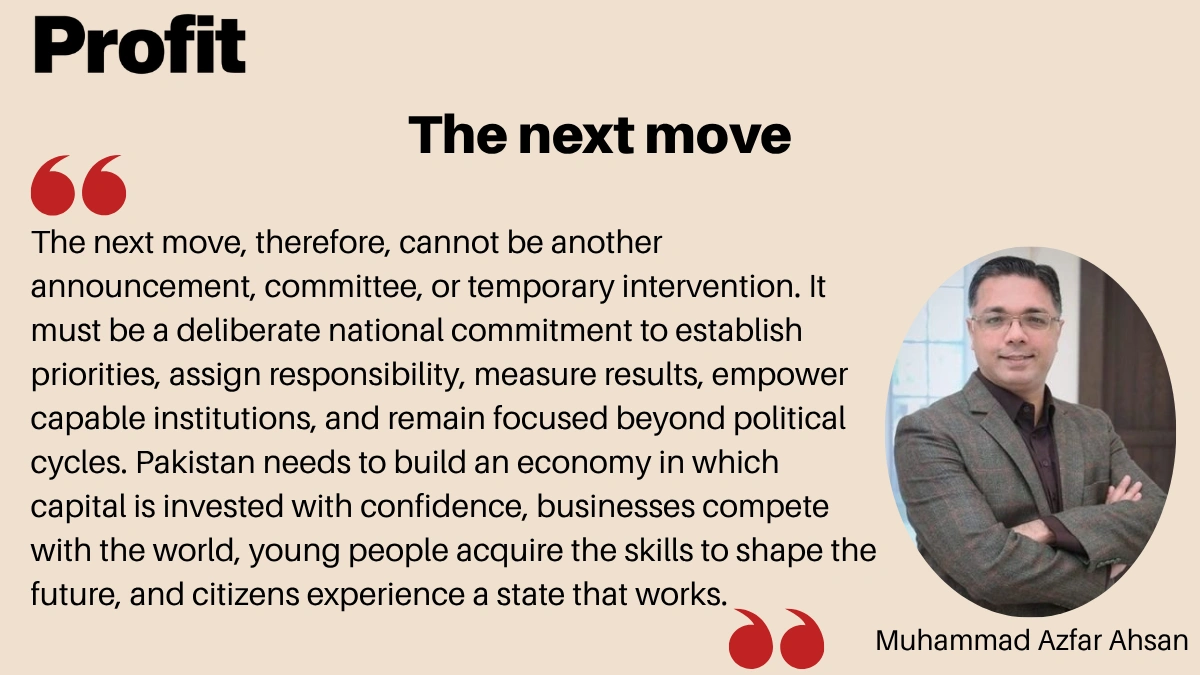
It also requires continuity. Governments will change, priorities will evolve and political mandates will differ. But the fundamental responsibilities of the state cannot be reset with every transition. Education, healthcare, justice, local government, institutional capacity, and public service delivery require long horizons. A state that constantly starts again cannot build lasting capability.
This is ultimately a question of institutional maturity. Mature states do not depend entirely on the preferences of individuals at the top. They build systems that preserve competence, carry institutional memory, enforce rules consistently, and continue delivering when political leadership changes.
But institutional reform will not be enough if the citizen remains an afterthought. The ultimate measure of the state is the distance between what the law promises and what the citizen experiences. Closing that distance should become a national priority, not as an exercise in administrative reform alone, but as a renewal of the relationship between the state and society.
Pakistan does not need a state that is omnipresent. It needs a state that is dependable: strong where only the state can be strong, restrained where society and markets can perform better, and relentlessly focused on the public goods that determine national capability.
The purpose of government is not to make citizens dependent on the government. It is to create the security, opportunity, and institutional confidence that allow citizens to become more capable, independent, and productive. A state succeeds when its institutions expand the choices available to citizens rather than narrowing them through uncertainty, privilege, or administrative friction. That is the foundation of a functioning social contract.
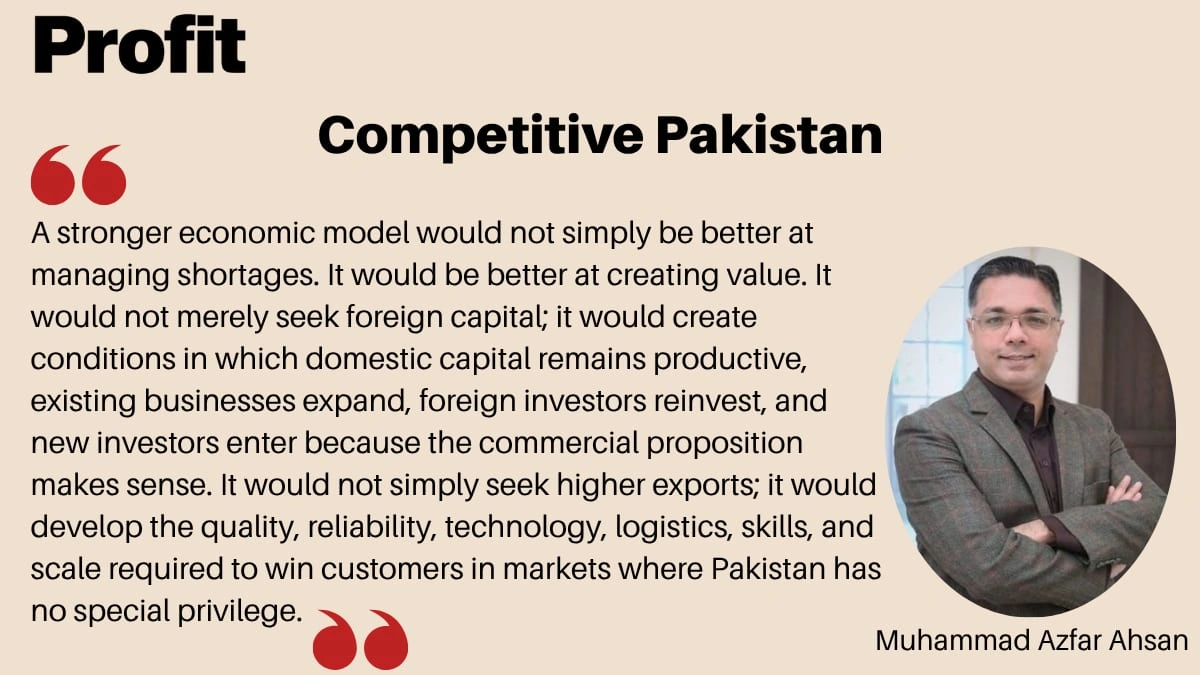
Pakistan’s next phase of development cannot be built only through higher investment, stronger exports, or faster economic growth. Those are essential, but they will not endure without institutions that citizens trust and services that allow people to participate meaningfully in the economy and society. Economic transformation ultimately depends on institutional transformation because capital, talent, and enterprise respond not only to incentives, but to the predictability of the environment in which they operate.
A country becomes stronger when its citizens believe the system is capable of working for them, not merely operating around them. It becomes more productive when citizens spend less energy navigating institutions and more energy building families, businesses, careers, and communities. It becomes more cohesive when people believe that merit can matter, effort can produce mobility, and the law can protect them without regard to influence.
Pakistan has enormous human potential. The question is whether our institutions will release it or continue to constrain it. The state does not need to promise everything. It needs to deliver what matters most, consistently, fairly and at scale.
When a child receives an education that expands their possibilities, a patient receives care without privilege, a citizen obtains justice without influence, a business can operate without arbitrary interference, a young person finds a pathway into productive work, and a family believes that effort can improve its future, the social contract ceases to be an idea. It becomes a lived reality.
That is when the state earns legitimacy. That is when trust becomes an economic asset, social stability becomes a development advantage, and citizenship becomes a source of confidence rather than frustration.
Pakistan’s future will ultimately depend not only on the strength of its economy, but on the strength of the relationship between its people and the institutions that serve them. Economic strength without institutional confidence will remain fragile; institutional strength without opportunity will remain incomplete.
Therefore, the real test is not whether the state is present. It is whether it is dependable when citizens need it, fair when citizens encounter it, and capable enough to deliver what citizens are entitled to expect. The state must, therefore, do more than govern. It must deliver.
Muhammad Azfar Ahsan is a public policy advocate, business strategist, and former Minister for Investment of Pakistan. He advises leading corporate entities on policy advocacy, strategic communications, investment strategy, and leadership positioning, and writes regularly on the economy, governance, and national development.

MUHAMMAD AZFAR SHAH
Articles