Rethinking FDI
By Muhammad Azfar Ahsan
FDI remains a reliable measure of how much capital enters an economy, but it fails to capture what happens after that capital arrives whether it gets reinvested, strengthens local firms, transfers technology, or builds lasting capability. The article proposes a broader framework called Capital Systems, which views investment as a continuous process involving four stages: Capital Entry (the inflow itself), Capital Absorption Capacity (institutional readiness to use it well), Capital Circulation (how capital moves and multiplies through the economy), and Capital Transformation (when foreign capital becomes durable national capability). Drawing on examples like the US, Singapore, Ireland and Vietnam, the article argues that countries with similar FDI levels often see very different outcomes because what matters most isn't how much capital comes in, but how effectively the economy absorbs, circulates and transforms it into long-term prosperity.
September 14, 2026
Published in The Pakistan Today on September 14, 2026
Foreign Direct Investment (FDI) has occupied a privileged position in economic policy for more than half a century. Governments celebrate rising inflows as evidence of investor confidence. International institutions monitor them as indicators of economic integration. Financial markets interpret them as signals of reform credibility, while policymakers routinely cite annual FDI figures as shorthand for competitiveness, investment attractiveness and economic success. Few economic indicators command greater political attention or shape public narratives more consistently.
Yet an important question remains largely unexplored: Does FDI still measure what today’s policymakers increasingly expect it to explain?
This is not a challenge to the integrity of FDI statistics. Compiled under internationally accepted standards developed by the International Monetary Fund (IMF) and the Organisation for Economic Co-operation and Development (OECD), FDI remains one of the world’s most reliable and internationally comparable measures of cross-border investment. It captures equity capital, reinvested earnings and intra-company debt that establishes a lasting investment relationship between firms operating across national borders. As a measure of capital entry, it remains indispensable.
The limitation is not what FDI measures; it is what FDI cannot measure. FDI measures how much productive capital enters an economy during a given period. It tells us remarkably little about what happens after that capital arrives. It does not reveal whether investment stimulates repeated rounds of reinvestment, strengthens domestic enterprises, accelerates technological diffusion, develops human capital, deepens financial markets or becomes embedded within the productive capabilities of an economy. In essence, FDI measures the movement of capital across borders far more effectively than it measures the enduring economic value that capital ultimately creates.
For much of the twentieth century, this distinction mattered less. Production was organized primarily within national economies, multinational corporations were comparatively fewer, and international investment generally followed a linear path. Capital entered a country, factories were established, production expanded, employment increased and economic gains were expected to follow. Under those conditions, measuring capital inflows provided a reasonable approximation of investment performance.
That world no longer exists.
The global investment landscape has undergone a profound transformation. Successive waves of globalization, technological change, digitalization, financial integration and geopolitical realignment have fundamentally altered both the nature of capital and the way it moves across borders. The latest UNCTAD World Investment Report 2026 illustrates this transition vividly. Global FDI recovered by 6 per cent in 2025 to approximately USD1.624 trillion, ending two consecutive years of decline. Yet the recovery was narrow and uneven, driven largely by investment in Artificial Intelligence (AI) infrastructure, semiconductors and energy, while investment across many manufacturing activities and infrastructure sectors remained subdued. Rather than signaling a return to pre-existing patterns, the report depicts an investment landscape increasingly shaped by geopolitical uncertainty, industrial policy, technological rivalry and economic security. Understanding investment today therefore requires far more than measuring the volume of capital crossing national borders.

The character of value creation has evolved just as profoundly. International organizations including UNCTAD, the World Trade Organization (WTO), the OECD and the World Intellectual Property Organization (WIPO) increasingly emphasize the growing importance of global value chains, intangible assets, innovation ecosystems and knowledge-intensive industries in shaping economic competitiveness. Software, data, intellectual property, research capability, advanced manufacturing, AI and organizational know-how have become as strategically important as physical capital itself. Capital today is no longer merely financial; it is simultaneously technological, organizational and knowledge-based.
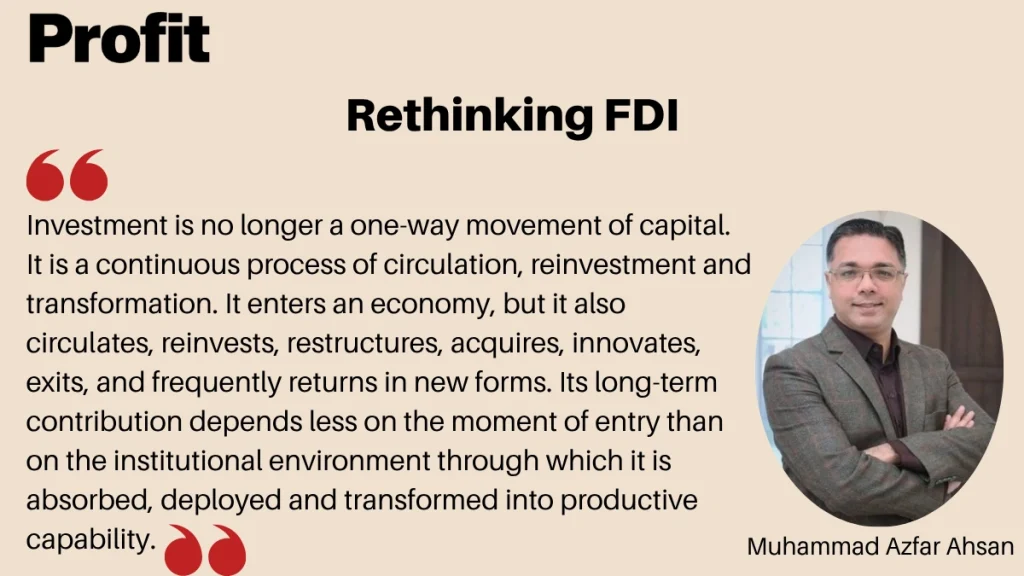
Investment is no longer a one-way movement of capital. It is a continuous process of circulation, reinvestment and transformation. It enters an economy, but it also circulates, reinvests, restructures, acquires, innovates, exits, and frequently returns in new forms. Its long-term contribution depends less on the moment of entry than on the institutional environment through which it is absorbed, deployed and transformed into productive capability.
This is where an increasingly important analytical gap begins to emerge. Annual FDI statistics remain essential because they measure capital entry with remarkable precision. The defining economic question of the twenty-first century, however, is increasingly about how that capital behaves after it enters. This article argues that investment should be understood not merely as a cross-border flow of finance, but as an integrated economic system through which capital is absorbed, circulated, transformed and converted into enduring productive capability. That broader perspective offers a more comprehensive explanation of why some economies consistently convert investment into sustained prosperity while others, despite attracting substantial inflows, struggle to generate lasting competitive advantage.
The modern theory of FDI emerged in an era very different from the one we inhabit today. In the decades following the Second World War, capital was relatively scarce, financial markets were less integrated, global production networks were in their infancy, and multinational enterprises operated on a far smaller scale than they do today. For developing economies, foreign investment was expected to supplement domestic savings, accelerate industrialization, create employment, transfer technology and strengthen managerial capability. Within that context, the central policy question was straightforward: How much productive capital was entering the economy?
It was in response to this question that the intellectual foundations of modern FDI theory were established. Stephen Hymer’s pioneering work explained why firms invest abroad despite the inherent disadvantages of operating in foreign markets, arguing that they do so because they possess firm-specific advantages capable of overcoming those costs. Raymond Vernon’s Product Life Cycle Theory demonstrated how production migrates across countries as products mature and technologies diffuse internationally. John H. Dunning’s influential Eclectic (OLI) Paradigm integrated ownership, location and internalization advantages into a comprehensive framework that remains the cornerstone of international business scholarship. Collectively, these contributions transformed the understanding of multinational enterprise and continue to shape investment policy, academic research and international economic analysis.

Their significance has not diminished. On the contrary, they remain indispensable for explaining why firms invest internationally, why they choose particular locations and how multinational enterprises organize cross-border production. The challenge is not that these theories have become obsolete, but that the global economy has evolved in ways that require extending their analytical reach.
Over the past four decades, the organization of international production has been fundamentally transformed. Successive waves of globalization, digitalization and technological innovation have enabled firms to coordinate increasingly sophisticated production, research, finance and logistics networks across multiple jurisdictions. As highlighted in the UNCTAD World Investment Report 2026, investment is becoming progressively concentrated in strategic sectors such as AI infrastructure, semiconductors, digital technologies and the energy transition, while geopolitical considerations, industrial policy and economic security are exerting growing influence over capital allocation. Competitive advantage is no longer determined primarily by market size or production costs. It is increasingly shaped by institutional quality, technological capability, skilled human capital, innovation ecosystems and resilience within global value chains.
The nature of capital itself has evolved. Financial capital is now inseparable from technology, intellectual property, data, organizational capability and specialized knowledge. In many of the world’s most valuable enterprises, intangible assets account for a substantial share of corporate value. Investment increasingly creates economic advantage not simply by financing physical production, but by transferring knowledge, strengthening innovation ecosystems, embedding firms within global networks and accelerating technological learning. Value creation has become cumulative, networked and knowledge-intensive rather than purely asset-based.
These structural changes have transformed the economic journey of capital. Following the initial investment, capital is continually reinvested, redeployed, restructured and combined with domestic capabilities. Enterprises expand into new markets, acquire strategic technologies, strengthen supplier networks, invest in research and development, upgrade workforce skills, integrate AI into production and respond dynamically to changing market conditions. Capital has become adaptive, iterative and continuously evolving rather than linear and static.
This evolution exposes an important analytical limitation. Annual FDI statistics continue to measure capital entry with remarkable precision, but they reveal comparatively little about the institutional and economic processes that determine whether investment ultimately strengthens productive capability, stimulates innovation, upgrades domestic enterprises or generates sustained national competitiveness. Two economies may record similar levels of annual FDI yet experience profoundly different development outcomes because the decisive variable lies not in the quantity of capital they attract, but in the quality of the system through which that capital is absorbed, circulated and transformed.
Recognizing this distinction does not require abandoning the classical theory of FDI. Quite the opposite. It builds upon its intellectual foundations. If Hymer explained why firms internationalize, Vernon illustrated how production evolves across borders, and Dunning identified the conditions that attract investment, the next frontier is to understand what determines if investment generates enduring economic capability after it has crossed those borders.
Economic history offers a recurring lesson. Nations rarely prosper simply because they attract capital. They prosper because they build institutions, capabilities and productive ecosystems that enable capital to compound over decades. Capital is mobile; capability is cumulative. The difference between the two helps explain why economies receiving similar levels of investment frequently experience remarkably different development trajectories. Understanding that distinction is essential if investment policy is to evolve from measuring financial inflows to creating enduring economic capability.
If the global economy has evolved beyond the assumptions that shaped conventional interpretations of Foreign Direct Investment, an obvious question follows: What analytical framework better explains how investment creates long-term economic value?
The answer is not another investment indicator, nor is it a call to replace FDI. FDI remains indispensable because it measures the entry of productive capital across national borders. Every meaningful investment strategy begins with attracting capital. The limitation is that capital entry represents only the beginning of the economic story. To understand investment in the twenty-first century, policymakers must also understand what happens after capital enters an economy.
This article proposes a broader conceptual framework: Capital Systems.
A Capital System views investment not as a single cross-border financial transaction, but as a dynamic and continuous economic process through which capital is absorbed, circulated, transformed, and multiplied into long-term productive capability. It recognizes that the true contribution of investment is determined not by the initial inflow itself, but by the quality of the institutional, financial, technological and entrepreneurial ecosystem through which that capital evolves over time.
This perspective complements rather than replaces classical FDI theory. If traditional FDI analysis explains why capital crosses borders, a Capital Systems perspective explains how capital creates enduring value after those borders have been crossed. Together, they provide a more complete understanding of investment in an economy increasingly characterized by knowledge, networks, technological innovation and continuous capital mobility.
The framework consists of four mutually reinforcing dimensions.
The first is Capital Entry. This is the gateway through which productive foreign capital enters an economy through greenfield investment, mergers and acquisitions, joint ventures, strategic partnerships or equity participation. FDI statistics measure this dimension exceptionally well and will remain indispensable because no economy can benefit from investment that never arrives.
The second is Capital Absorption Capacity. Before investment can generate meaningful economic value, an economy must possess the institutional capability to absorb it effectively. This extends far beyond investment promotion. It encompasses the quality of governance, regulatory predictability, the rule of law, macroeconomic stability, infrastructure, financial markets, skilled human capital, innovation ecosystems, contract enforcement and policy continuity. The work of Nobel laureate Douglass North demonstrated that institutions shape long-term economic performance by defining the incentives that govern economic activity. Likewise, Michael Porter showed that productivity depends fundamentally on the environment in which firms compete, innovate and continuously upgrade. Their combined insights reinforce a central proposition of this framework: incentives may attract investment, but institutions determine whether investment compounds into enduring prosperity.
The third dimension is Capital Circulation. Once effectively absorbed, investment begins to move through the wider economy. Enterprises expand production, suppliers strengthen their capabilities, financial institutions allocate resources more efficiently, universities collaborate with industry, technologies diffuse, workers acquire new skills, entrepreneurs establish new ventures and successful firms reinvest their earnings. Investment also evolves through acquisitions, partnerships, innovation and international expansion. Capital therefore behaves less like a static stock and more like a continuously circulating economic resource whose value increases through interaction across the broader economy. The effectiveness of this circulation can be understood through the concept of Capital Velocity, the speed, frequency and productivity with which capital is reinvested, redeployed and converted into successive rounds of economic activity. High Capital Velocity enables a single investment to generate multiple waves of innovation, enterprise creation, technological upgrading, productivity growth and employment. Low Capital Velocity, by contrast, characterizes economies where investment remains isolated, generates limited spillover effects and depends disproportionately on attracting new inflows to sustain growth. Over time, economies with higher Capital Velocity derive substantially greater value from similar levels of investment because capital continually creates new productive opportunities rather than remaining confined within individual projects.
The fourth dimension is Capital Transformation. This is the stage at which investment evolves into durable national capability. Domestic enterprises become more competitive, technological knowledge diffuses across industries, research and innovation accelerate, supply chains deepen, new industries emerge and firms integrate more effectively into regional and global value chains. At this stage, foreign capital is no longer simply external finance; it has become an integral component of the economy’s productive architecture and a driver of long-term competitiveness.
Viewed through this framework, the objective of investment policy changes fundamentally. Success is no longer measured simply by the volume of capital entering an economy during a particular year. It is measured by the effectiveness with which capital is absorbed, circulated, transformed and multiplied into enduring productive capability. The central policy question therefore shifts from “How much capital did we attract?” to “How much long-term economic value did that capital create?” That distinction represents far more than a change in measurement. It marks a fundamental shift in the way investment itself is understood.
A conceptual framework is valuable only if it explains economic reality more effectively than existing approaches. The critical test, therefore, is whether a Capital Systems perspective provides a more convincing explanation of why some economies consistently transform investment into sustained prosperity while others, despite attracting substantial capital, struggle to achieve lasting economic transformation.
The international evidence strongly suggests that it does.
The latest UNCTAD World Investment Report 2026 portrays an international investment landscape undergoing profound structural change. While global investment has recovered, the gains have been uneven and increasingly concentrated across a relatively small number of economies and strategic sectors. AI infrastructure, semiconductors, digital technologies and the energy transition have attracted a disproportionate share of new investment, while geopolitical tensions, industrial policy, economic security and supply-chain resilience are playing an increasingly decisive role in shaping capital allocation. In such an environment, attracting investment is becoming progressively more competitive, while sustaining it requires capabilities that extend far beyond traditional investment promotion.
The world’s most competitive economies illustrate this reality.
The United States remains one of the world’s largest recipients of FDI while simultaneously being one of its largest sources of outward investment. Similar patterns can be observed in economies such as Singapore, the Netherlands and Switzerland. Through the narrow lens of annual net inflows, substantial outward investment might appear to represent capital leaving the domestic economy. Yet these same economies consistently rank among the world’s leaders in productivity, innovation, research intensity, entrepreneurship and business competitiveness.
The apparent contradiction disappears once investment is viewed through the lens of Capital Systems.
In mature economies, outward investment frequently reflects strength rather than weakness. Globally competitive firms expand into new markets, acquire strategic technologies, diversify production, optimize supply chains and position themselves closer to customers, talent and innovation hubs. At the same time, these economies continue to attract fresh investment because they offer what investors value most: institutional credibility, policy stability, regulatory predictability, independent legal systems, sophisticated financial markets, world-class universities, advanced infrastructure, highly skilled human capital and vibrant innovation ecosystems. Capital moves continuously through domestic and international markets, generating successive cycles of reinvestment, innovation and capability development that reinforce long-term competitiveness.
The experience of smaller but highly successful economies reinforces the same conclusion. Singapore’s transformation cannot be explained by investment incentives alone. It reflects decades of institutional consistency, efficient public administration, strategic infrastructure, openness to international trade, sustained investment in education and a relentless focus on competitiveness. Ireland combined a stable and predictable business environment with investment in higher education, research capability and deep integration into high-value technology industries. Vietnam complemented export-oriented industrialization with infrastructure development, workforce upgrading, industrial clustering and integration into global manufacturing value chains. In each case, foreign investment became transformative because it operated within institutions capable of converting capital into enduring productive capability.
The same pattern is evident at the level of firms. Both the OECD’s Benchmark Definition of Foreign Direct Investment (Fourth Edition) and successive UNCTAD World Investment Reports, including the 2026 edition, show that reinvested earnings account for a significant share of global FDI flows. Existing investors frequently contribute more to future investment than first-time entrants because they already understand the operating environment, possess established supplier relationships and have confidence in local institutions. Their willingness to expand operations and reinvest profits is therefore one of the strongest market-based indicators of the quality of an economy’s investment ecosystem. Initial investment signals confidence; repeated investment demonstrates confidence sustained through experience.
This insight carries an important implication for policymakers. Considerable effort is often devoted to attracting new investors through international roadshows, promotional campaigns, and fiscal incentives. While these initiatives remain important, long-term competitiveness depends at least as much on the experience of investors already operating within the economy. Economies that encourage existing firms to expand production, strengthen supplier networks, invest in research and development, transfer technology, upgrade workforce capabilities and undertake successive rounds of reinvestment are far more likely to generate durable economic value than those that focus primarily on attracting new inflows each year.
The Capital Systems framework also helps explain why economies recording similar levels of annual FDI frequently achieve very different development outcomes. The decisive variable is rarely the quantity of capital entering an economy in a particular year. Rather, it is the quality of the institutional and productive ecosystem that enables capital to be absorbed efficiently, circulate productively, generate knowledge spillovers, strengthen domestic enterprise, accelerate innovation and continuously create new competitive advantages.
Ultimately, investment attraction and investment transformation are not competing objectives; they are sequential stages of the same economic process. Capital attraction initiates economic activity. Capital transformation determines whether that activity evolves into sustained productivity, resilience and long-term prosperity. In an era increasingly defined by strategic technologies, geopolitical fragmentation and knowledge-intensive competition, the economies that succeed will not necessarily be those that attract the greatest volume of capital. They will be those that build the strongest Capital Systems.
The implications of this perspective extend far beyond the interpretation of investment statistics. They challenge the way governments formulate investment policy, the way international institutions assess competitiveness, the way investors evaluate long-term opportunity and, ultimately, the way economic development itself is understood. More fundamentally, they invite a reconsideration of what investment policy is intended to achieve in an increasingly turbulent global economy.
For decades, investment strategies have been dominated by the pursuit of larger FDI inflows. Governments have competed through tax incentives, fiscal concessions, special economic zones, investment promotion campaigns and regulatory reforms designed to attract foreign capital. These measures undoubtedly influence investment decisions and, under appropriate conditions, improve a country’s attractiveness. Yet international experience increasingly demonstrates that incentives alone rarely determine whether investment becomes a durable source of economic transformation.
The more important questions begin after the initial investment.
Does investment encourage existing firms to expand and reinvest? Does it strengthen domestic enterprises through technology transfer, managerial learning and integration into global value chains? Does it deepen local supplier networks, enhance workforce capabilities, stimulate research and innovation, improve productivity and accelerate industrial upgrading? Does it strengthen resilience by enabling firms to adapt to technological disruption, geopolitical fragmentation and changing patterns of international production? Or does investment remain concentrated in isolated projects with limited spillover effects and modest long-term impact?
These questions redefine the purpose of investment policy. The objective is no longer simply to maximize capital inflows; it is to maximize the long-term economic value created from every unit of productive capital. Capital attraction remains essential, but capital transformation becomes the ultimate measure of success.
This perspective also reshapes the meaning of competitiveness. In the coming decades, the most successful economies are unlikely to be distinguished solely by their ability to attract investment. They will be distinguished by their ability to build institutions that encourage reinvestment, accelerate innovation, strengthen domestic enterprise, develop human capital, deepen productive ecosystems, and continuously upgrade national capabilities. In a world increasingly driven by knowledge, technology and strategic competition, institutional quality has become one of the most durable sources of comparative advantage.
The latest UNCTAD World Investment Report 2026 reinforces this conclusion. International investment is entering an era characterized by geopolitical uncertainty, industrial policy, technological rivalry and increasingly selective capital allocation. Competition for investment is becoming more intense, while the conditions required to convert investment into sustained development are becoming more demanding. The challenge before policymakers is therefore no longer limited to attracting capital. It is to build economies capable of absorbing, deploying, circulating and transforming that capital into enduring productive capability.
FDI will remain one of the world’s most important economic indicators. It measures capital entry with remarkable precision and will continue to serve as an essential benchmark for governments, investors and international institutions. Yet FDI alone cannot fully explain why some economies consistently translate investment into innovation, productivity, resilience and prosperity while others do not. Those outcomes depend on the strength of the broader economic system within which investment operates.
That is the central proposition of this article. Classical FDI theory explains why firms invest across borders and why certain locations attract international capital. The Capital Systems framework proposed here seeks to explain what determines the long-term value created after that capital arrives. The two perspectives are not alternatives; they are complementary. One explains the movement of capital. The other explains its transformation.
The twentieth century confronted a world in which the principal challenge was attracting scarce capital. The twenty-first century presents a fundamentally different reality. Capital is more abundant, more mobile, more knowledge-intensive and more strategically selective than at any time in modern economic history. AI, advanced manufacturing, digital infrastructure, critical minerals, energy-transition technologies and resilient supply chains are reshaping both the direction and the purpose of global investment. In this environment, the decisive question is no longer where capital can go, but where it can create the greatest long-term capability.
Perhaps that is the most important lesson of the modern investment landscape. Foreign Direct Investment measures how capital enters an economy. Sustainable prosperity depends on what that capital becomes after it enters. FDI is the gateway. Capital Systems determine whether that gateway leads to enduring prosperity.
Muhammad Azfar Ahsan is a public policy advocate, business strategist, and former Minister for Investment of Pakistan. He advises leading corporate entities on policy advocacy, strategic communications, investment strategy, and leadership positioning, and writes regularly on the economy, governance, and national development.

MUHAMMAD AZFAR SHAH
Articles